
Partner Exercises (Sotai Dosa, 相対動作)
Tai Sabaki (体さばき) 1 — Tenkan (転換) (Gyaku-hanmi Katate-dori)
Key point: From katate-dori, turn the body and enter to your partner’s side.
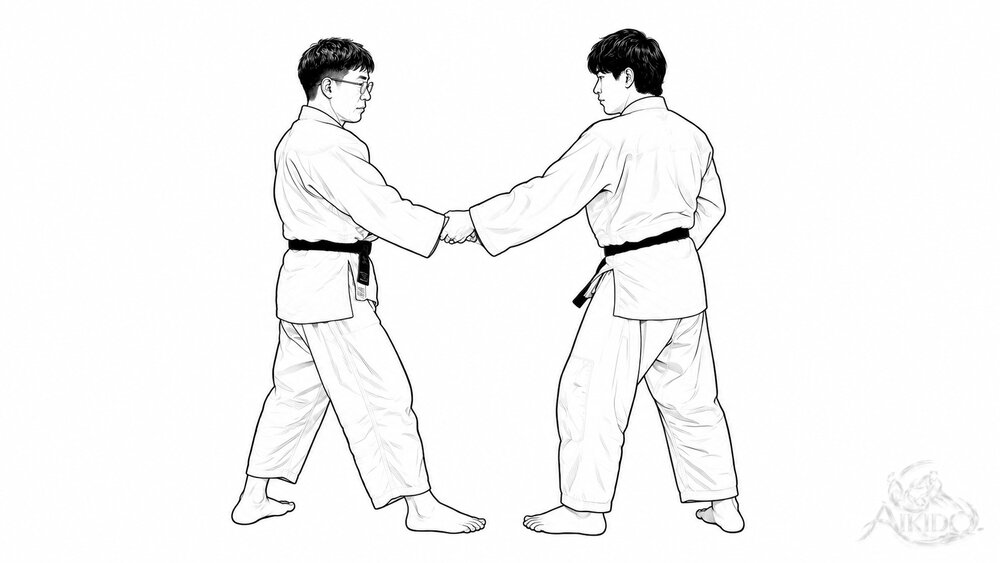
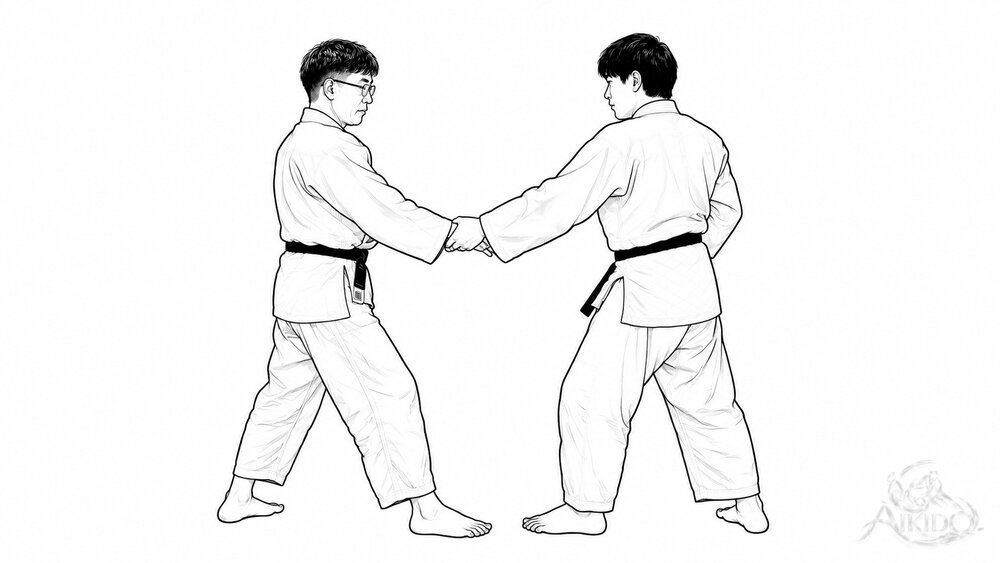
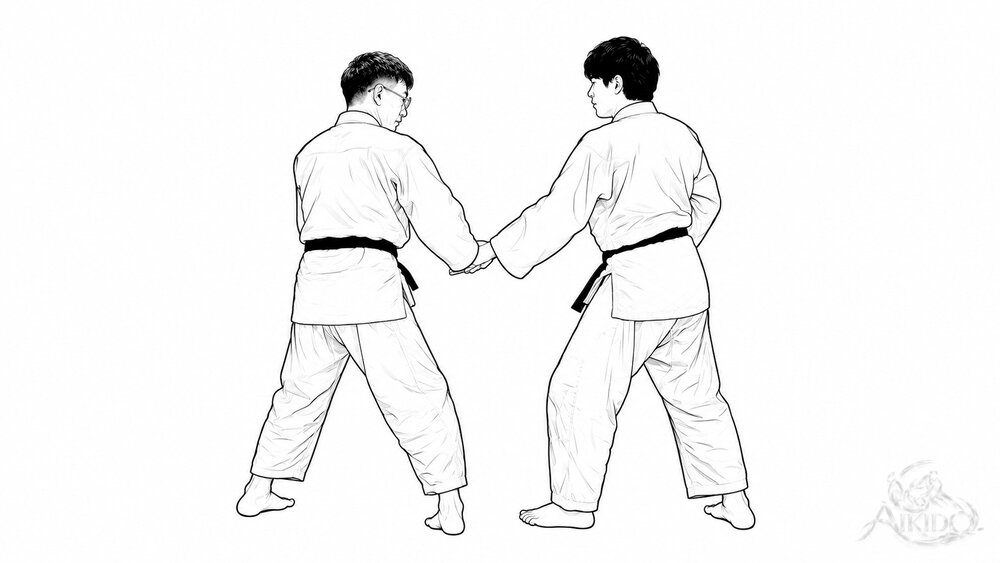
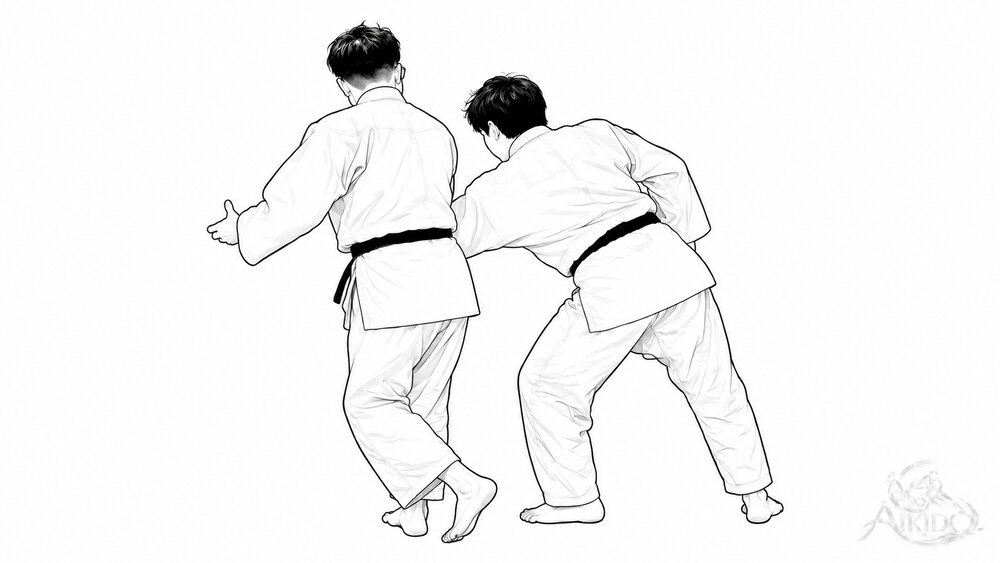
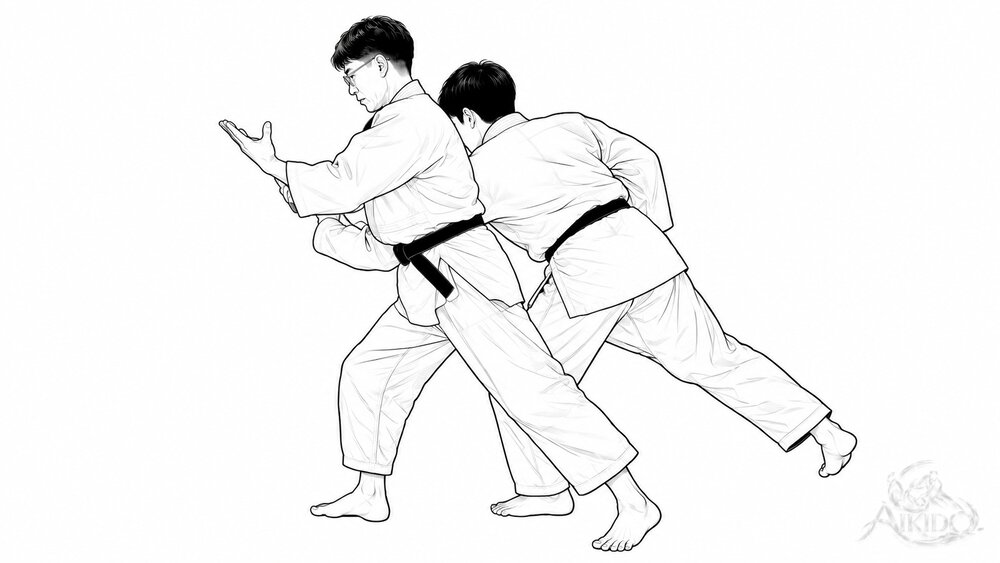
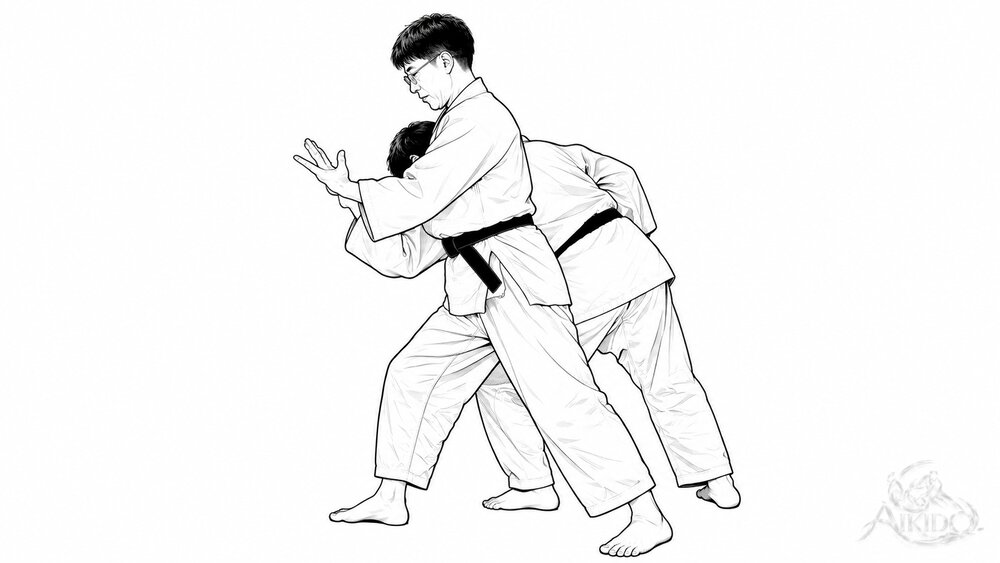
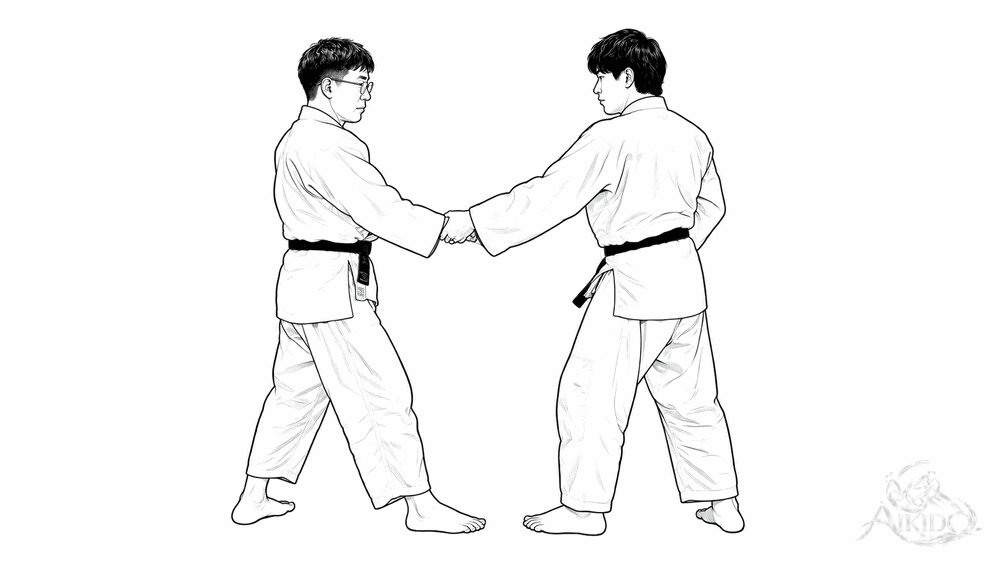
1 Migi gyaku-hanmi; uke grabs tori’s right wrist → 2 Step the right foot one step forward → 3 Turn 180 degrees on the right foot in tenkan-ashi → 4 Drawing the left foot back, move to your partner’s side. The tegatana extends forward, charged with kokyu-ryoku
Tenkan is a body movement in which you turn the body in tenkan-ashi and move to your partner’s side. In time with the movement of tenkan-ashi, extend the tegatana forward with the intention of sending power out through the fingertips. In migi gyaku-hanmi katate-dori, step the right foot one step in okuri-ashi to the outside of your partner’s front foot. Turn the body 180 degrees on that foot, and after turning form hanmi. Be aware of the body’s center line, with the feeling of conveying the power of your legs and hips into the extended tegatana.
- Stable, centered on the hips: As the body turns, it receives and redirects your partner’s power, and the power produced by that turn is conveyed to the tegatana to break your partner’s balance. Be aware of a balanced movement centered on the hips.
Tai Sabaki (体さばき) 2 — Irimi (入身) (Gyaku-hanmi Katate-dori)
Key point: From katate-dori, enter to your partner’s side and break their balance.
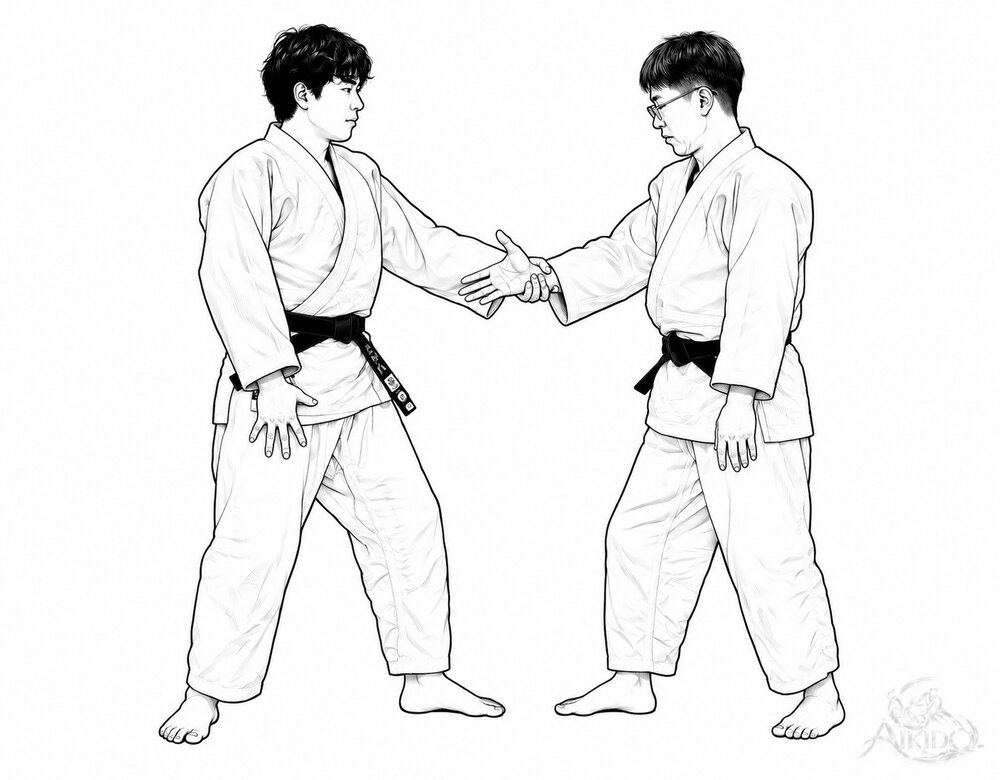
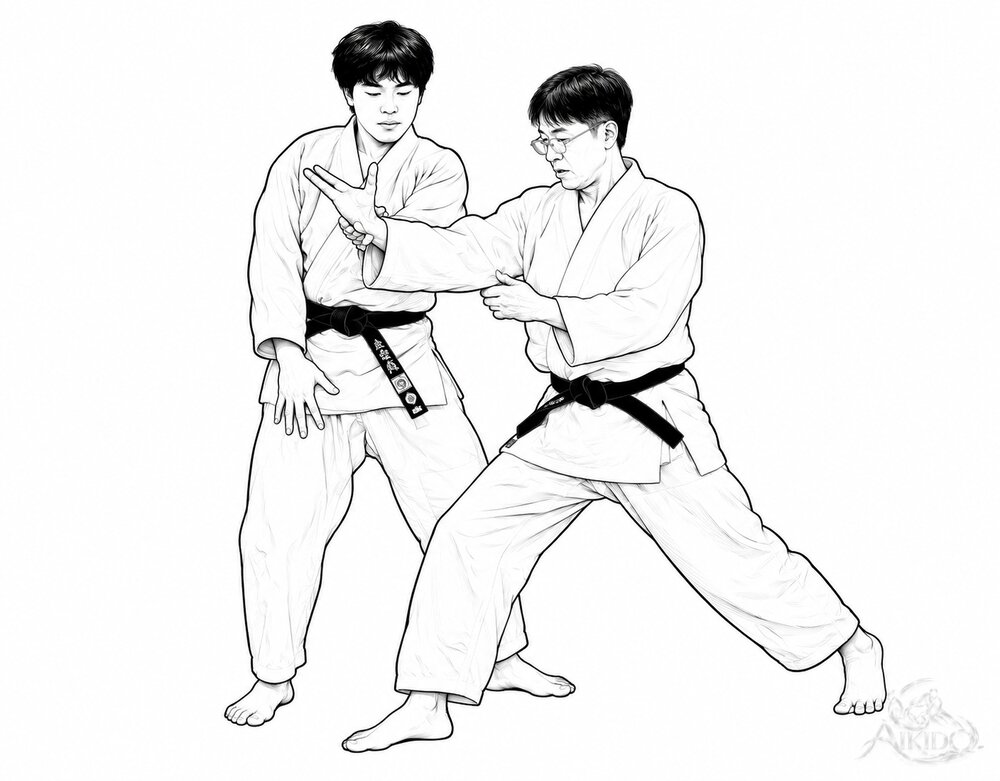
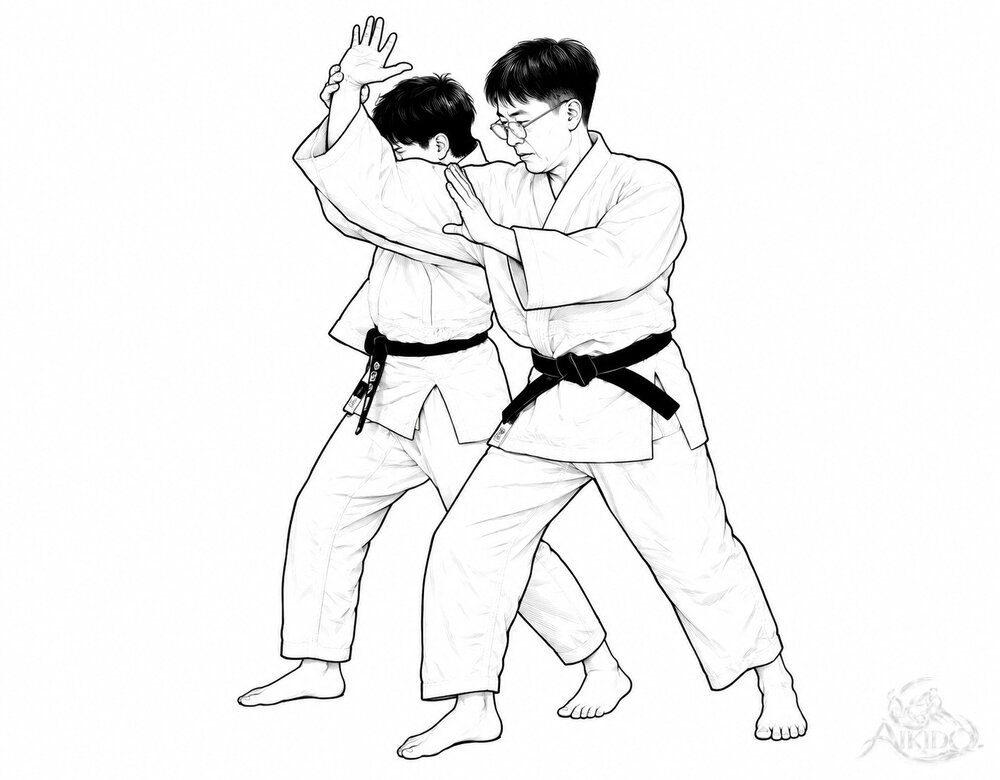
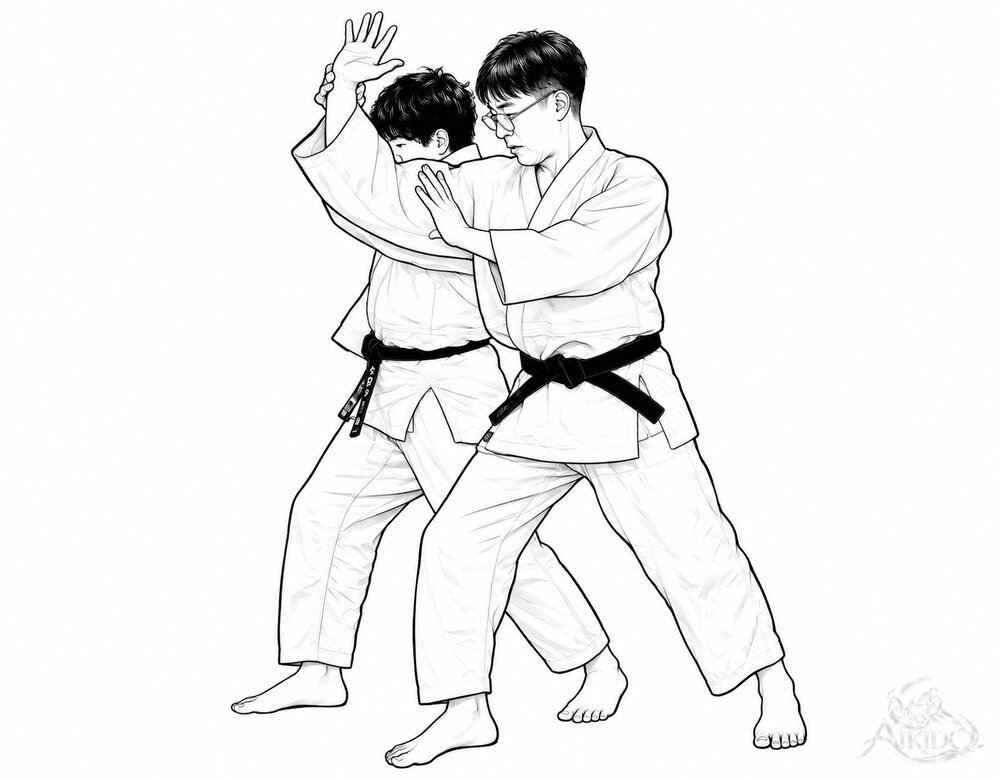
Irimi from gyaku-hanmi katate-dori is a body movement in which you enter toward your partner’s side in ayumi-ashi while cutting the tegatana up along your own center, breaking your partner’s balance. In hidari gyaku-hanmi katate-dori, the moment uke grabs your left hand, step the right foot toward your partner’s side in ayumi-ashi. In time with that movement, bring the tegatana to your own center, then step the left foot in ayumi-ashi again. When you cut the tegatana up to face height, uke’s posture collapses diagonally backward.
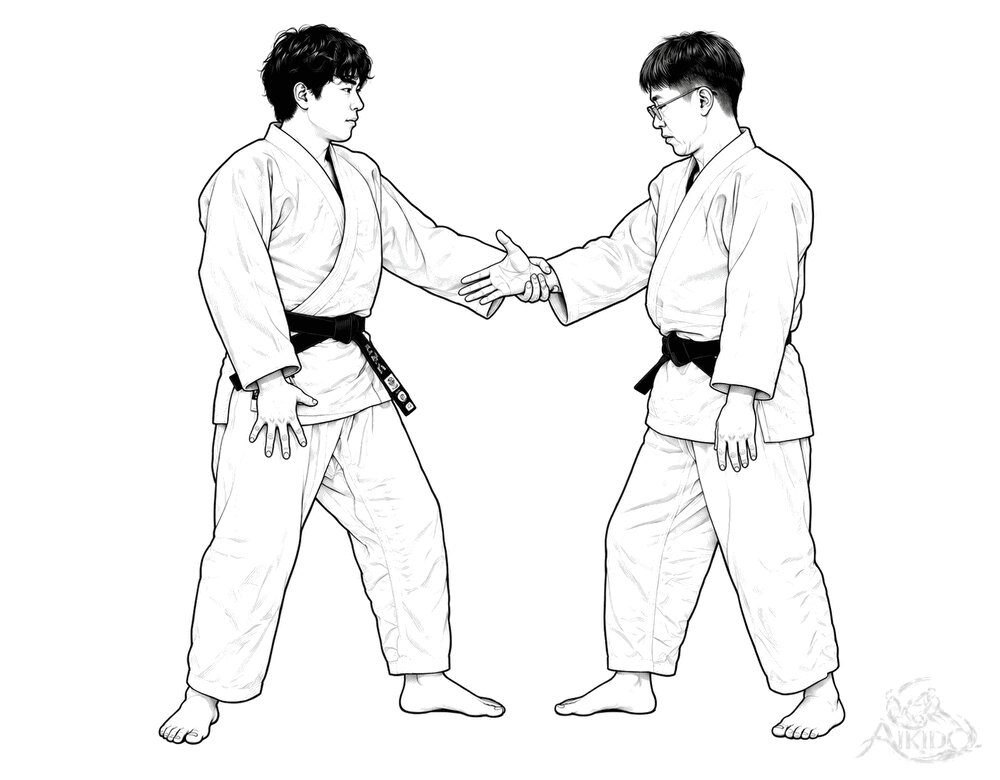
- Lead your partner with the tegatana: In time with the movement of entering to your partner’s side, cut the tegatana of the grabbed hand up toward your own center. When it reaches face height, your partner’s wrist is twisted and their posture collapses.
Tai Sabaki (体さばき) 3 — Irimi (Shomen-uchi)
Key point: Against your partner’s shomen-uchi, move off the line of attack and enter to your partner’s side.
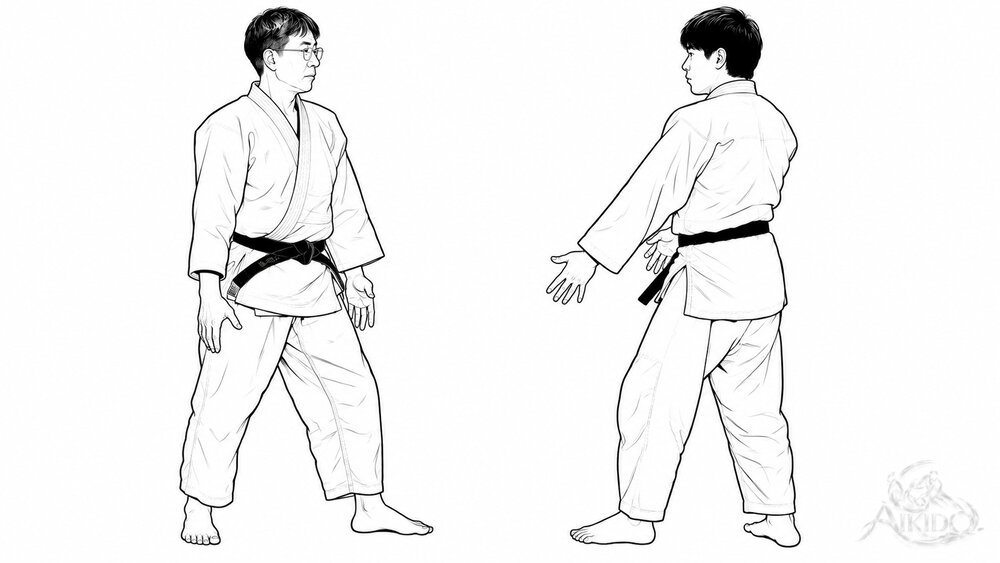
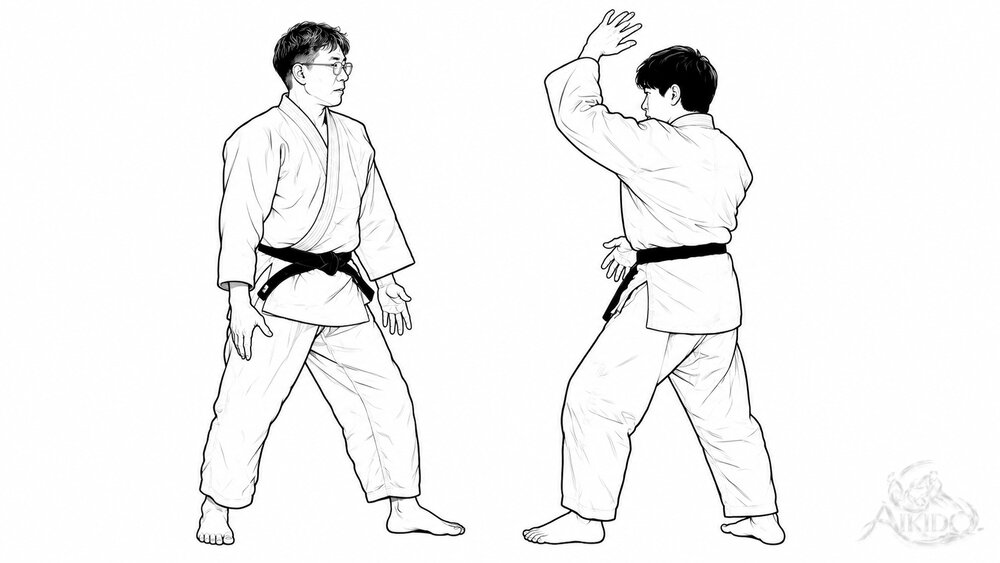
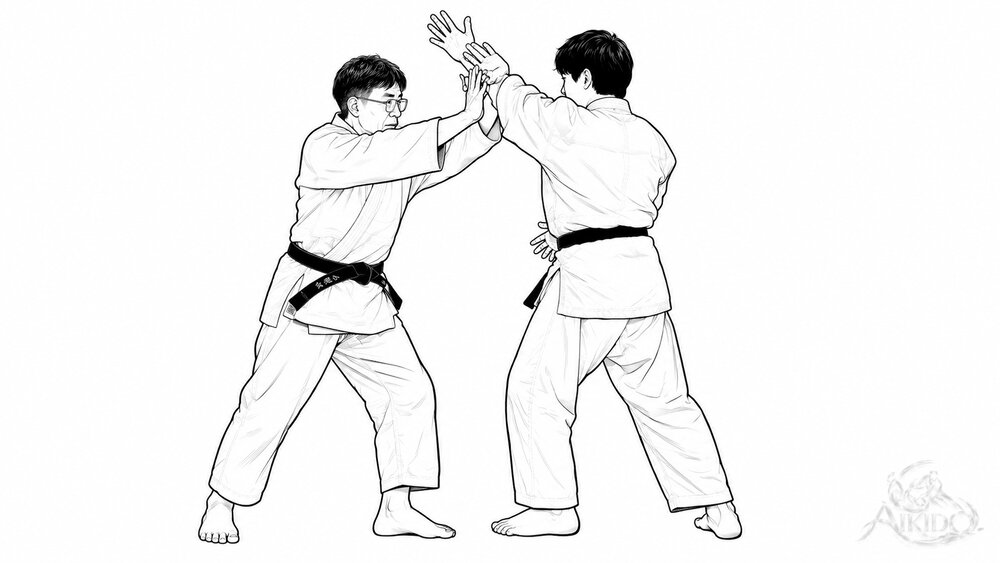
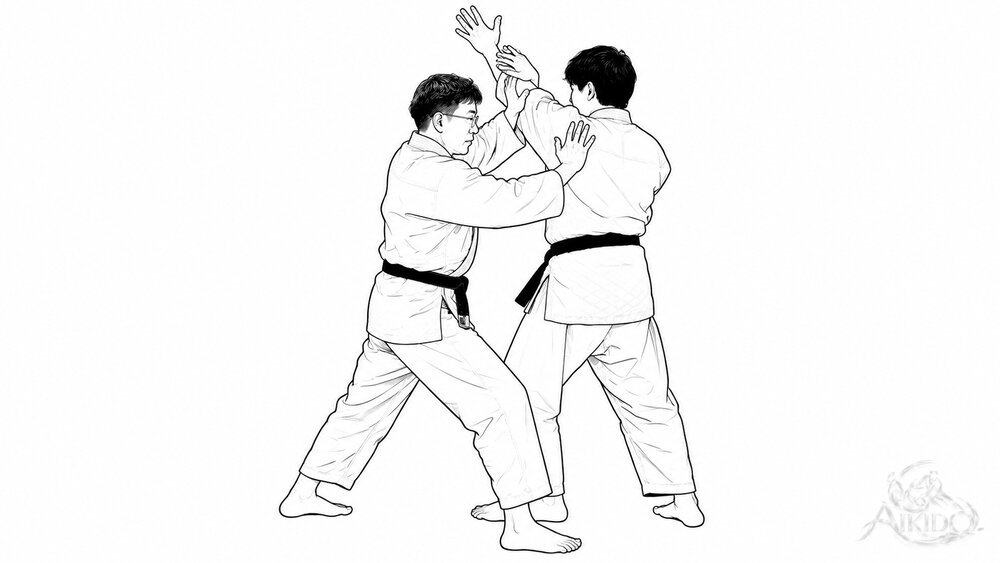
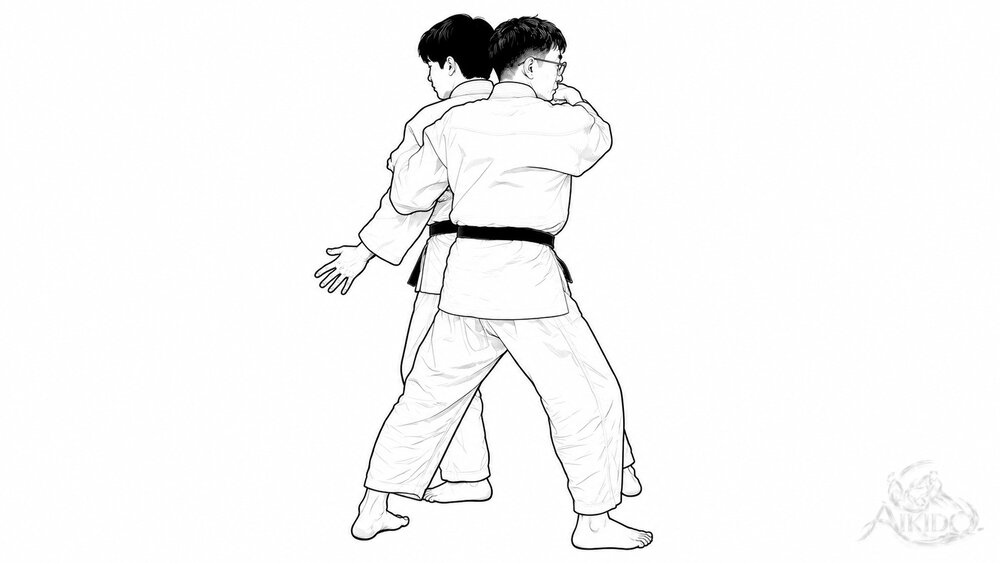
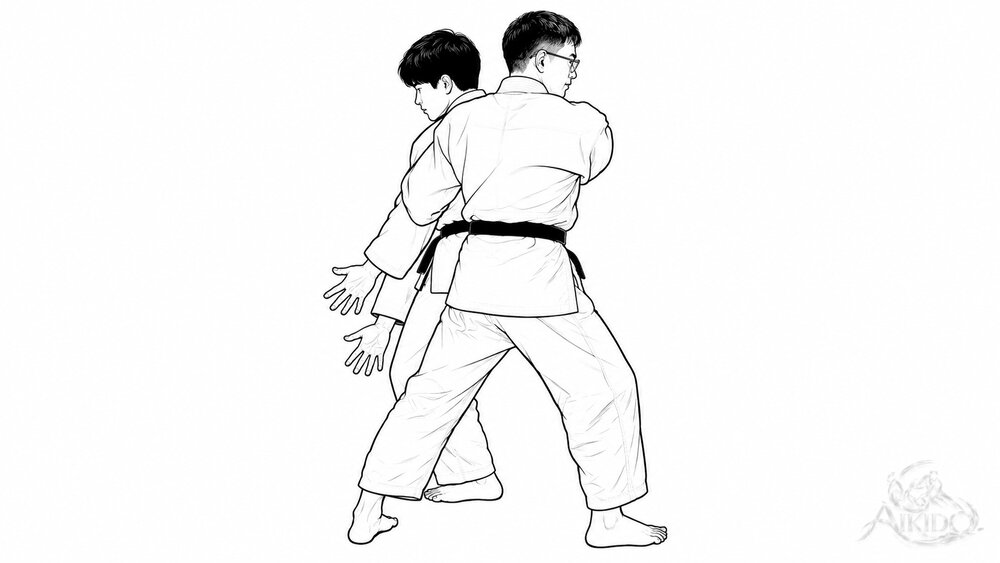
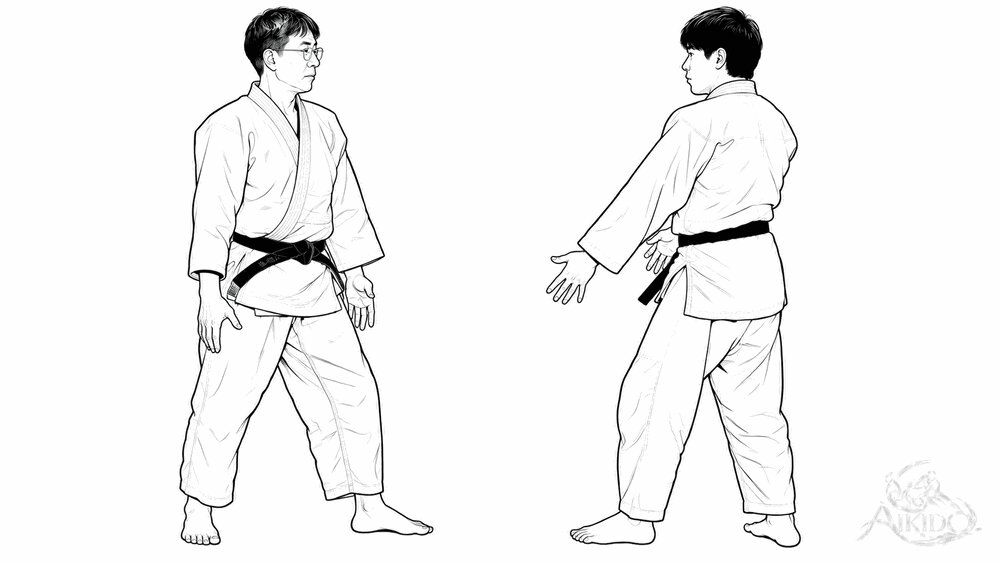
When your partner attacks with shomen-uchi, this body movement takes you off the line of attack of your own accord and into the side of your partner’s body. In hidari ai-hanmi, your partner strikes shomen-uchi with the left hand. At that moment, control the strike with your left tegatana and advance with ayumi-ashi, right foot first, to your partner’s outside (to the right as you see it). At the same time, lead your partner with the tegatana and take the back of their neck with your right hand. In this moment you bring your body to your partner’s side, standing side by side with them.
- Control your partner’s strike with the tegatana: In hidari ai-hanmi, control your partner’s shomen-uchi with your left tegatana. It is important to meet it with the tegatana from a position where you do not take the full force of the strike. The key is to move your body off the line of attack.
- Step with the back foot, deep to your partner’s side: As you control the shomen-uchi with the tegatana, enter with ayumi-ashi, back foot first, deep to your partner’s side. Step slightly to the outside of your partner so that your body leaves the path of the attack. The key is that when irimi is complete, you are standing side by side with your partner.
Tai Sabaki (体さばき) 4 — From Irimi to Tenkan (Shomen-uchi)
Key point: After irimi, turn the body again in tenkan-ashi to break your partner’s posture.
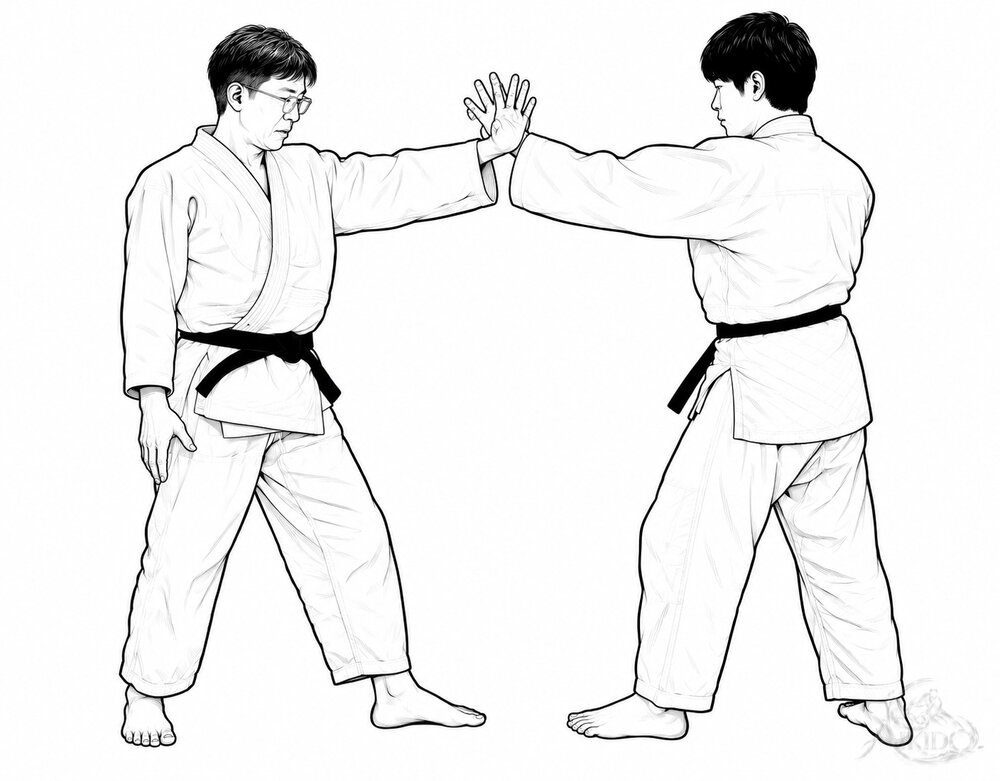
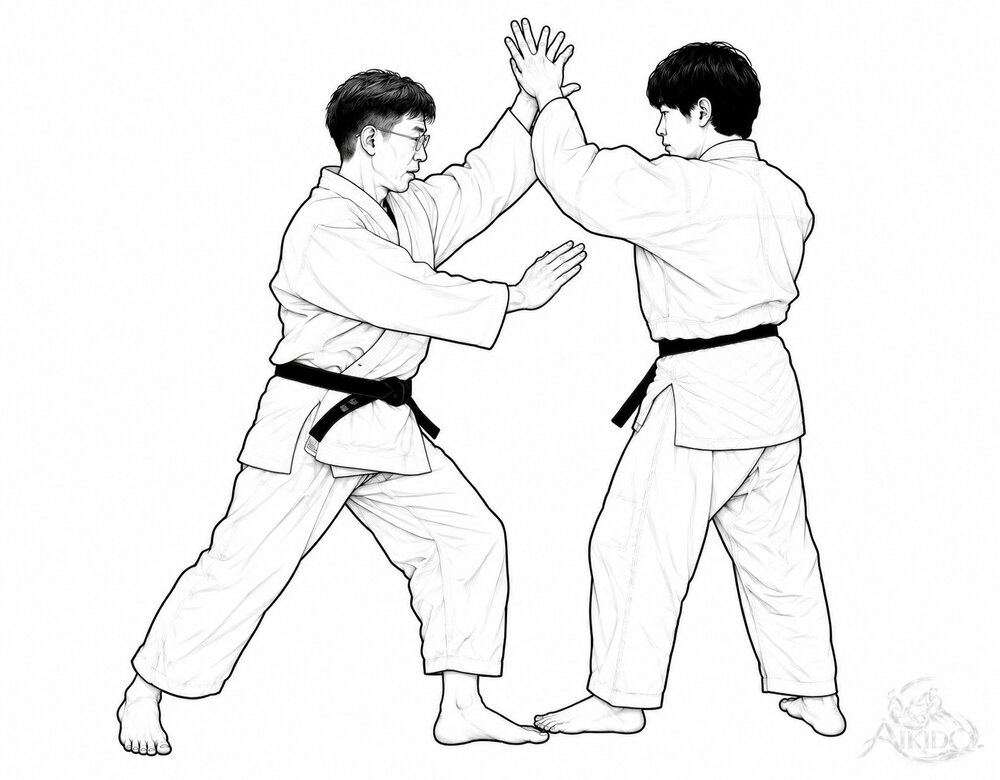
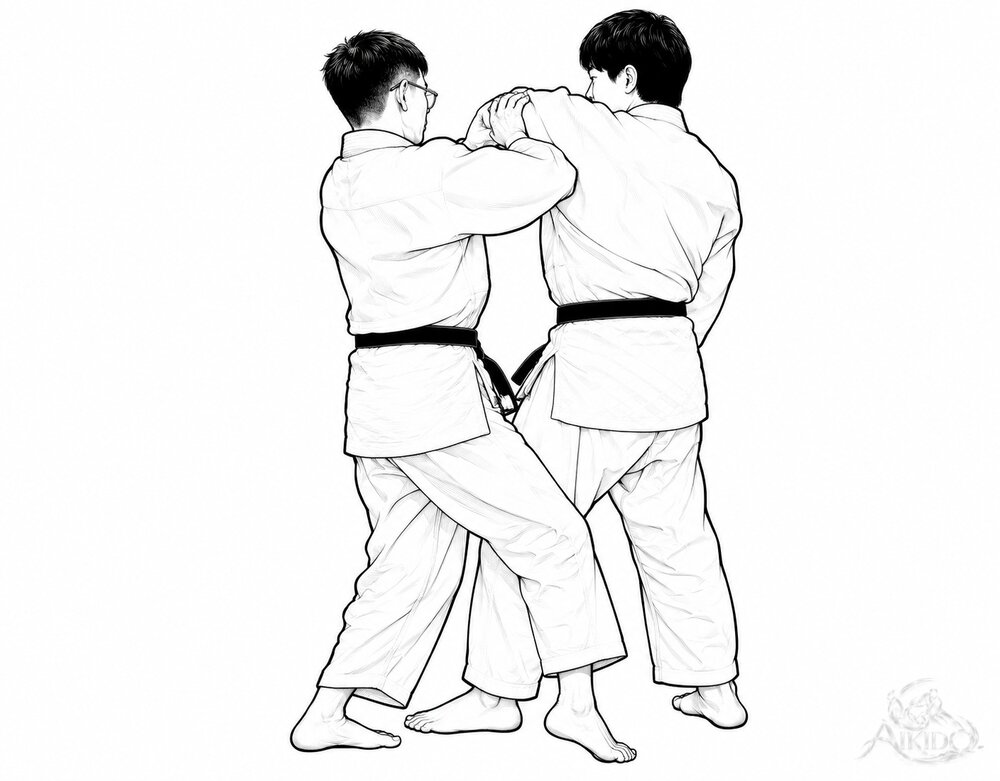
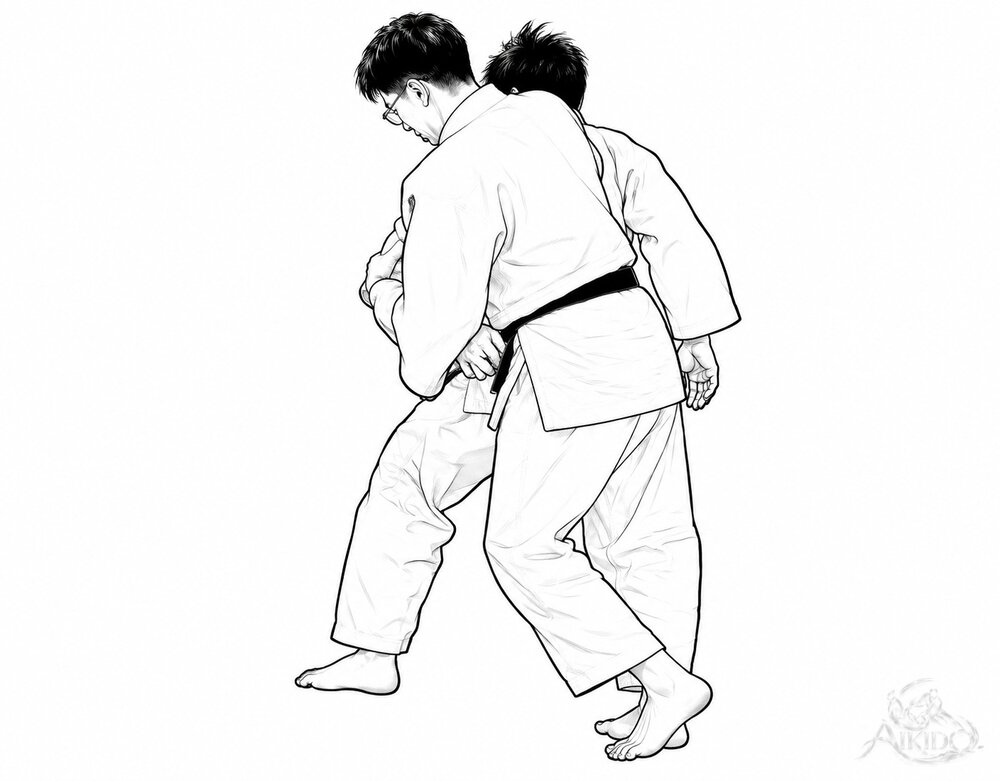
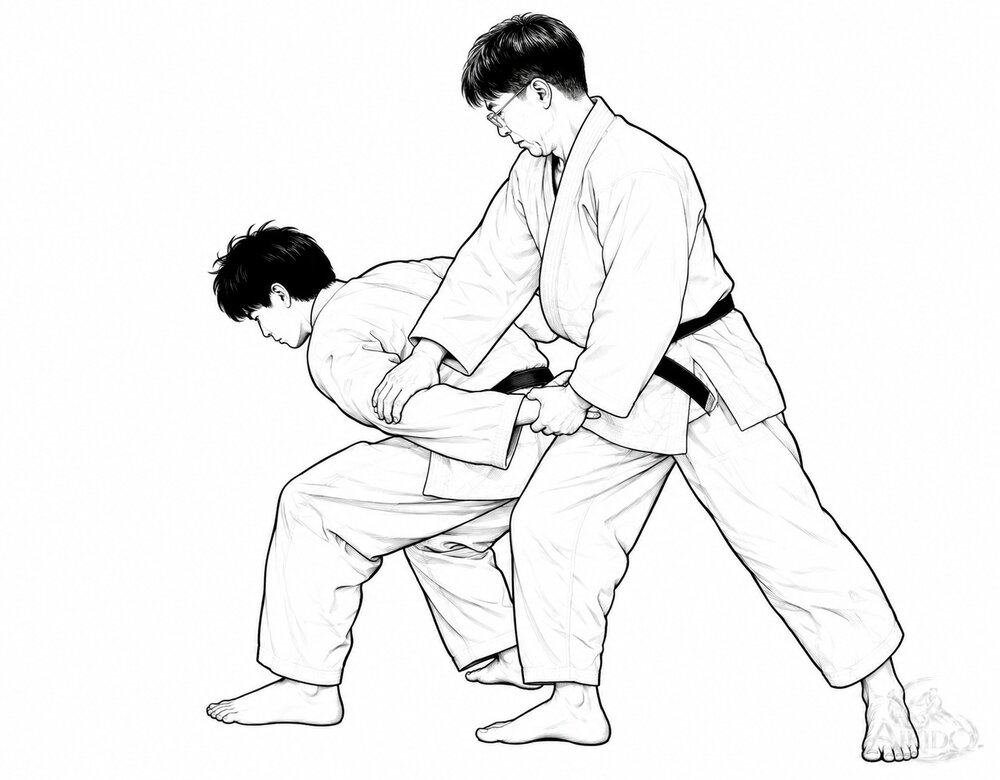
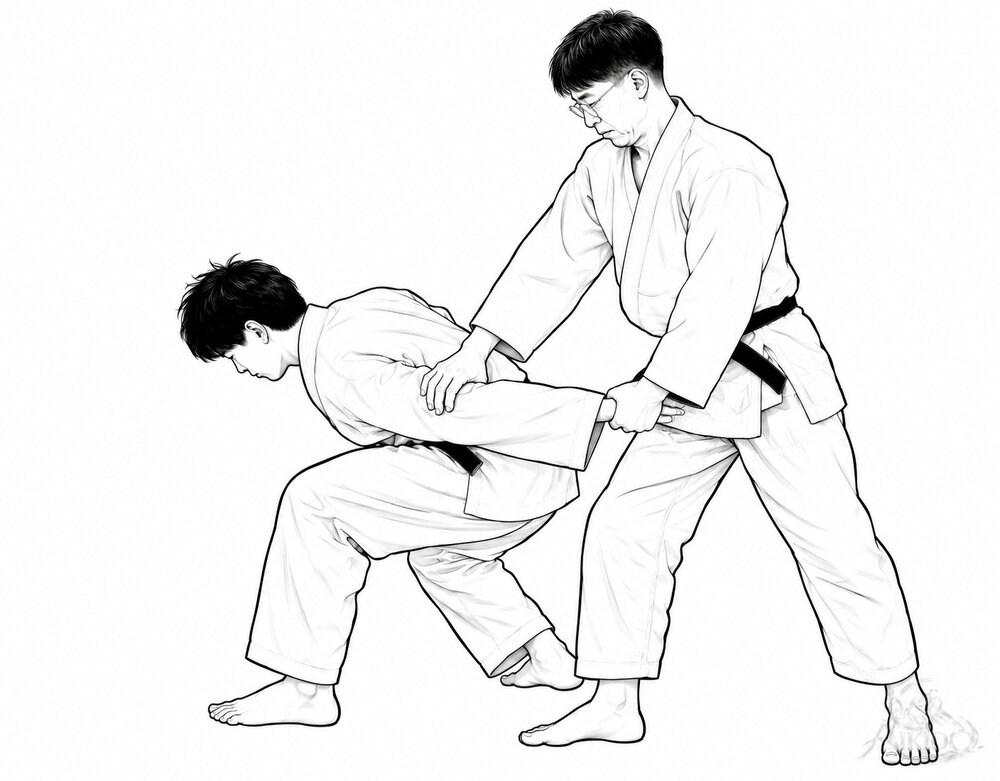
Adding the tenkan body movement to the irimi against shomen-uchi you have just learned develops it into a movement closer to the actual technique, shomen-uchi irimi nage. In hidari ai-hanmi, first enter to your partner’s side with irimi. From there, on the right foot, draw the left foot far back and turn the body 180 degrees in tenkan-ashi. In time with this movement, lead your partner with the left tegatana while the right hand holds the back of your partner’s neck.
- Keep the flow smooth: It is important that the movement does not break as you go from irimi into tenkan. Irimi and tenkan only work to break your partner’s balance when they are joined. Make full use of the body’s turning power.
- Hold the body’s axis firmly: As you turn 180 degrees in tenkan-ashi, lead your partner with the tegatana to break their balance. If your axis wobbles here, you cannot turn smoothly. Firmly hold the line that runs from the pivot foot up through the upper body.
Tai Sabaki (体さばき) 5 — Tenshin (転身) (Yokomen-uchi)
Key point: Against your partner’s yokomen-uchi, open the body to the side and break your partner’s balance.
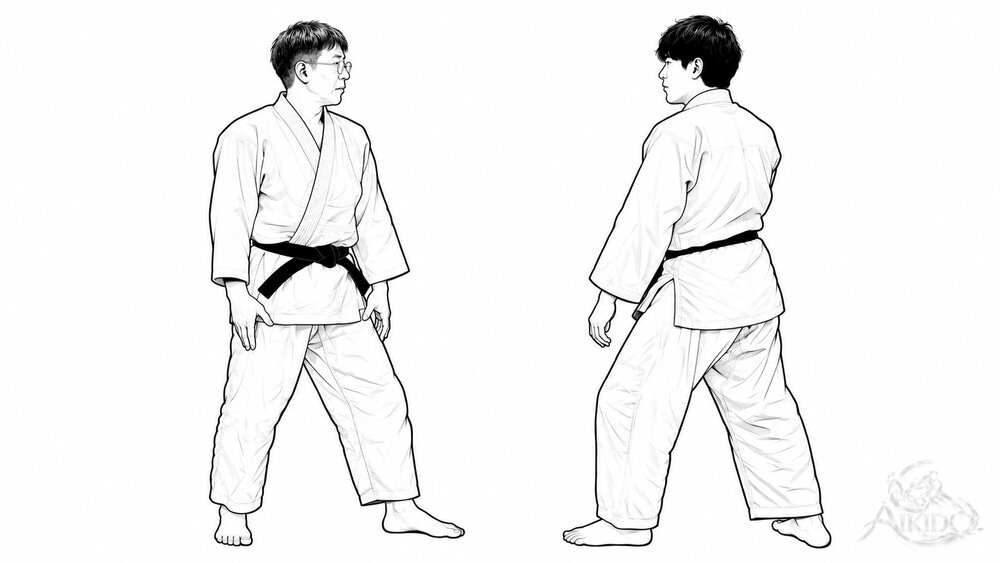
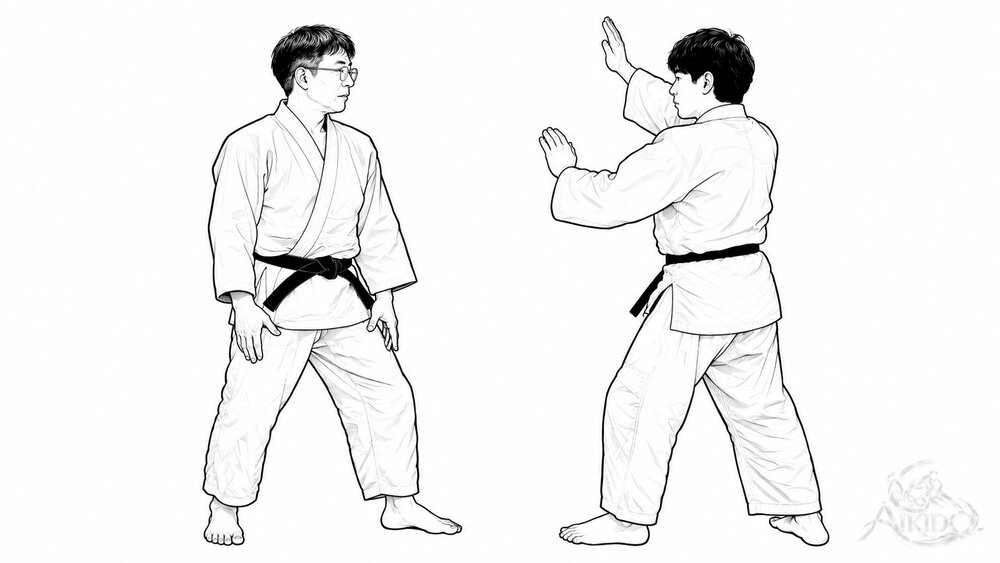
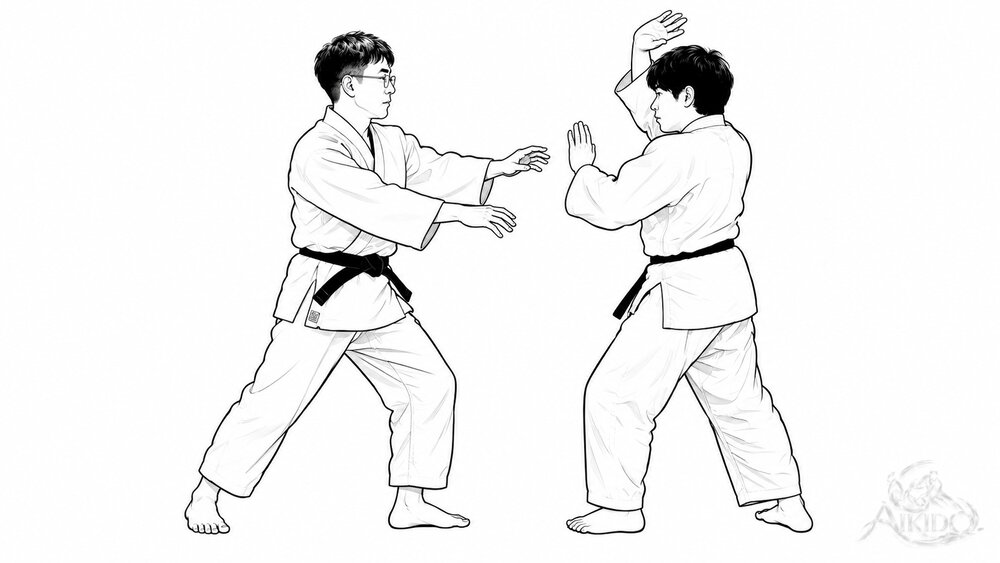
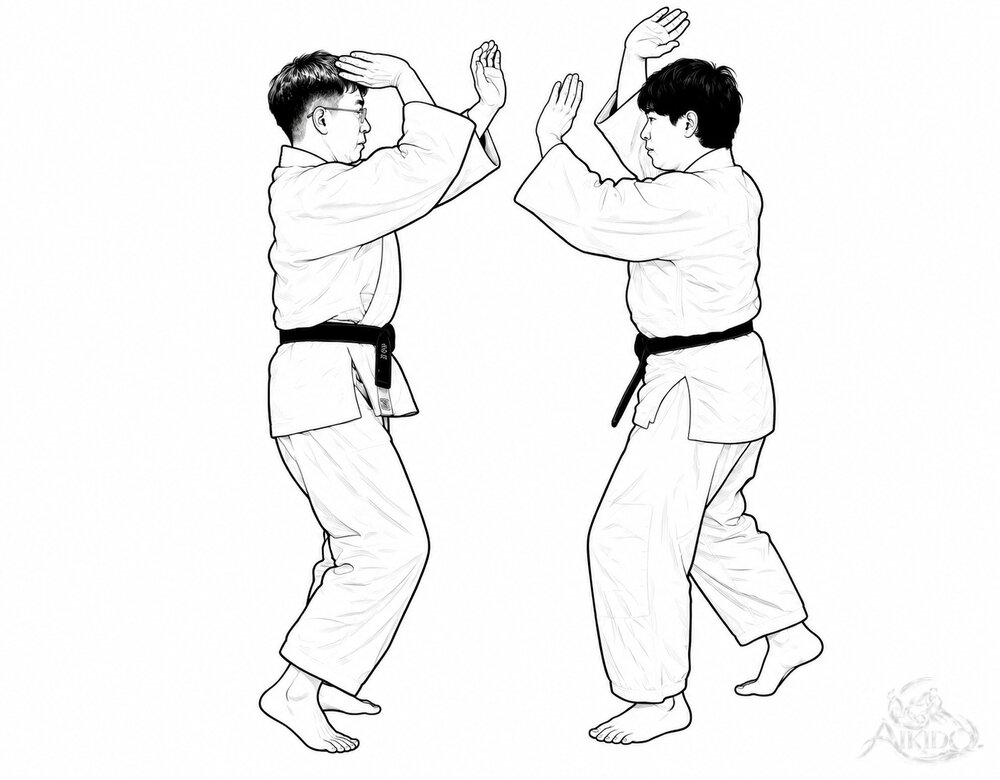
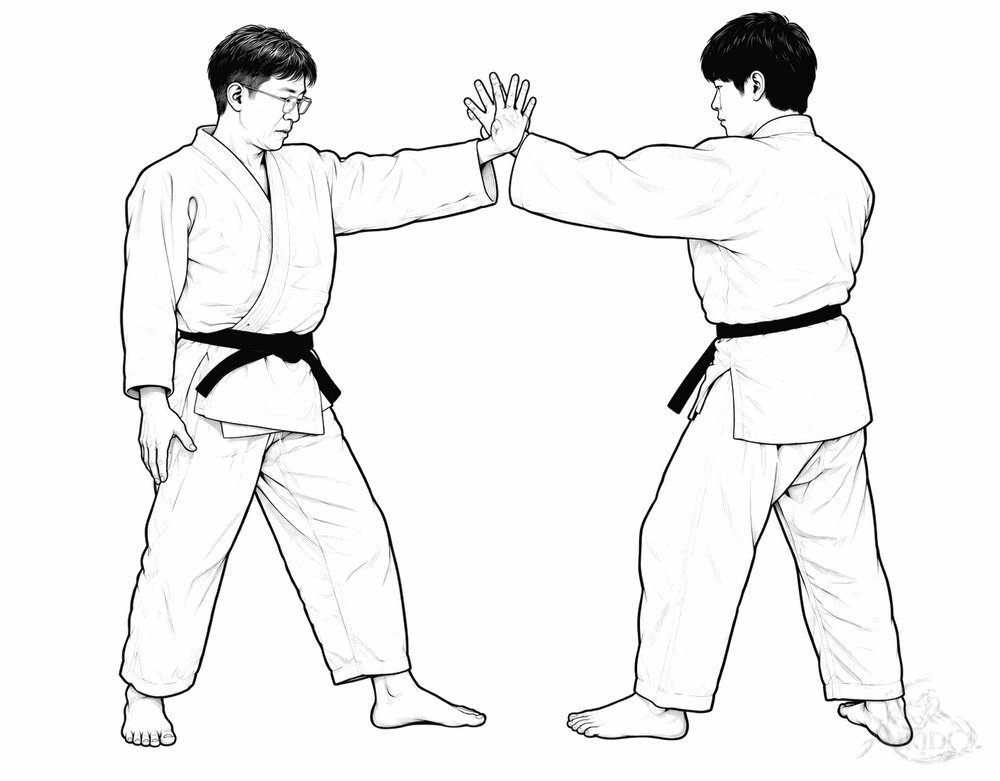
This is a body movement in which, against your partner’s yokomen-uchi, you open the body to the side and lead your partner with the tegatana to break their posture. In hidari ai-hanmi, your partner strikes yokomen-uchi with the right hand. Control it with your left tegatana while opening the right foot (the back foot) to the right, taking your body off the path of the attack. At the same time, deliver atemi (当て身) to your partner’s face with the right tegatana and lead it straight down. Then draw the left foot back, continuing the movement of the upper body, to break your partner’s posture.
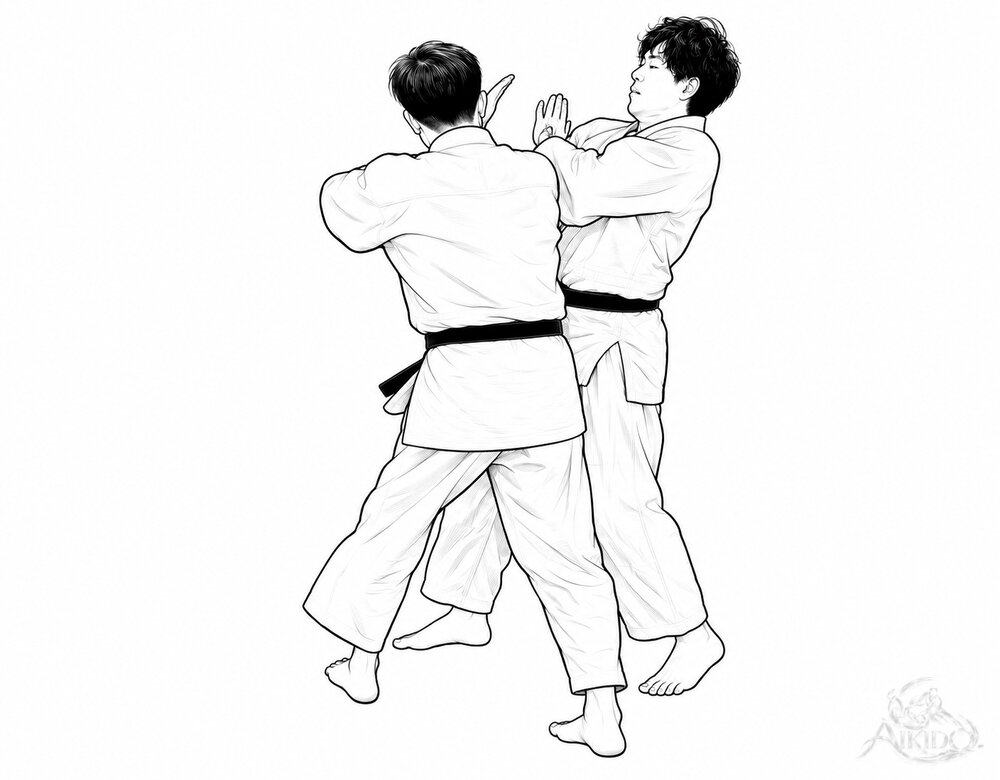
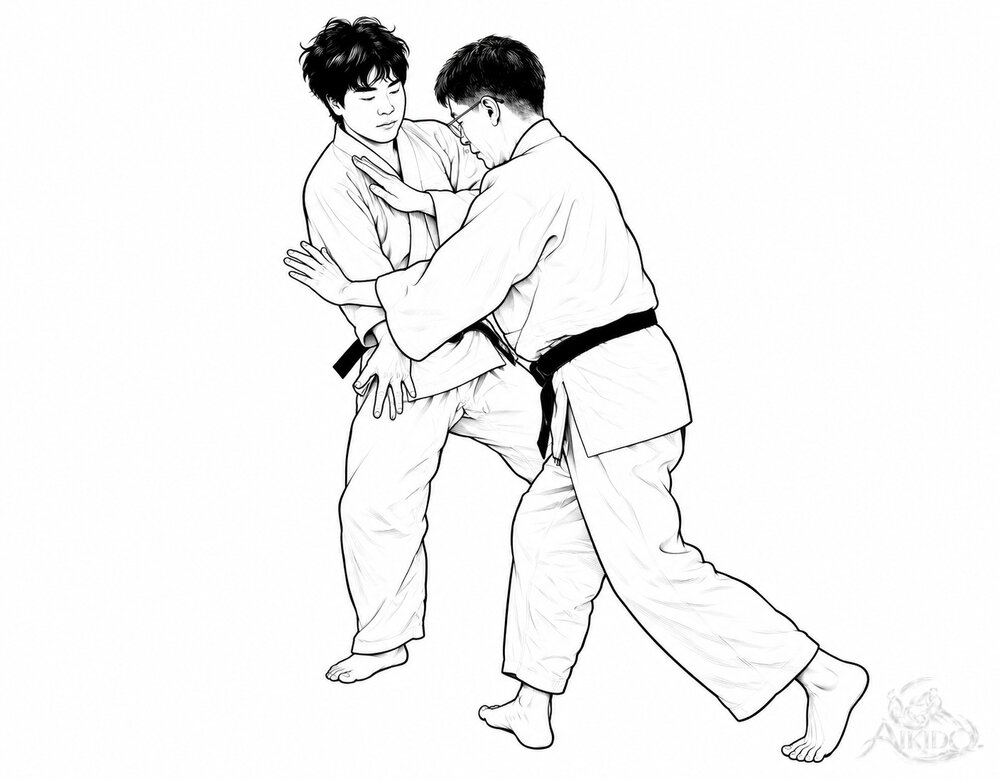
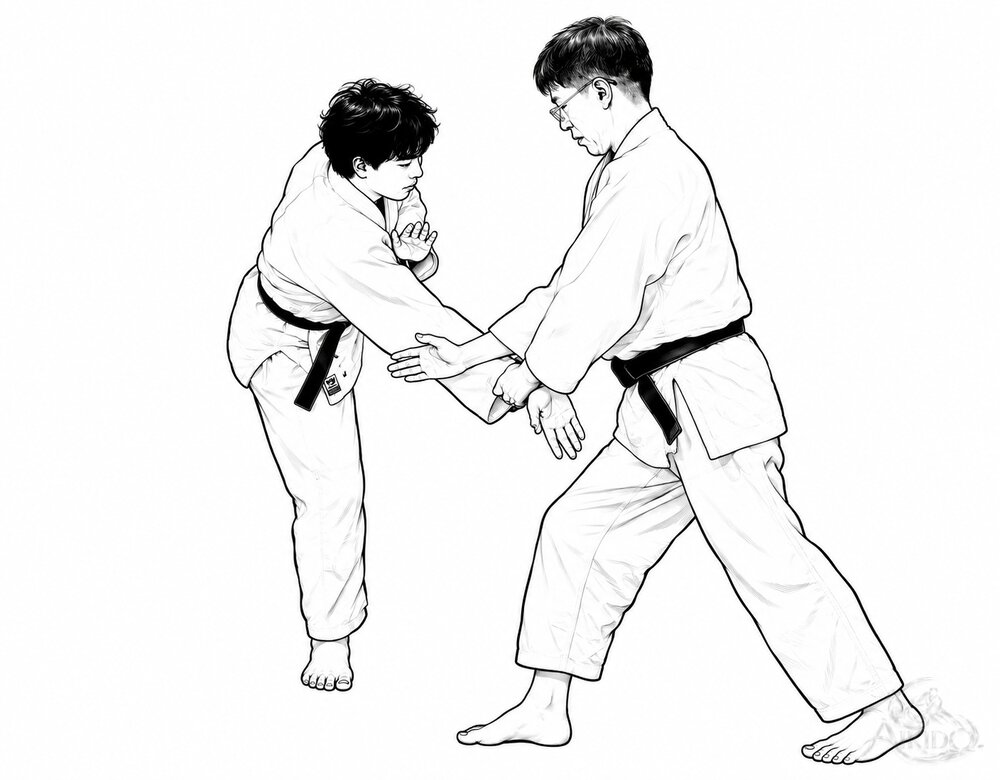
5 Control the yokomen-uchi with the left tegatana and deliver atemi with the right → 6 Open the right foot to move off the line, cutting the tegatana down → 7 Draw the left foot back and break your partner’s balance
- Match the descending movement of the tegatana: As your partner brings the tegatana down at an angle, control it with your left tegatana in time with that movement and lead it down as if drawing an arc. At the same time, deliver atemi with the right hand and, following the movement of the left tegatana, break your partner’s balance.
- Open the body to avoid the attack: The key to tenshin is opening the front foot. Your body then leaves the path of your partner’s attack, so you can avoid the yokomen-uchi and break your partner’s balance at the same time. It is important to make use of both the movement of the body and the movement of the tegatana together.
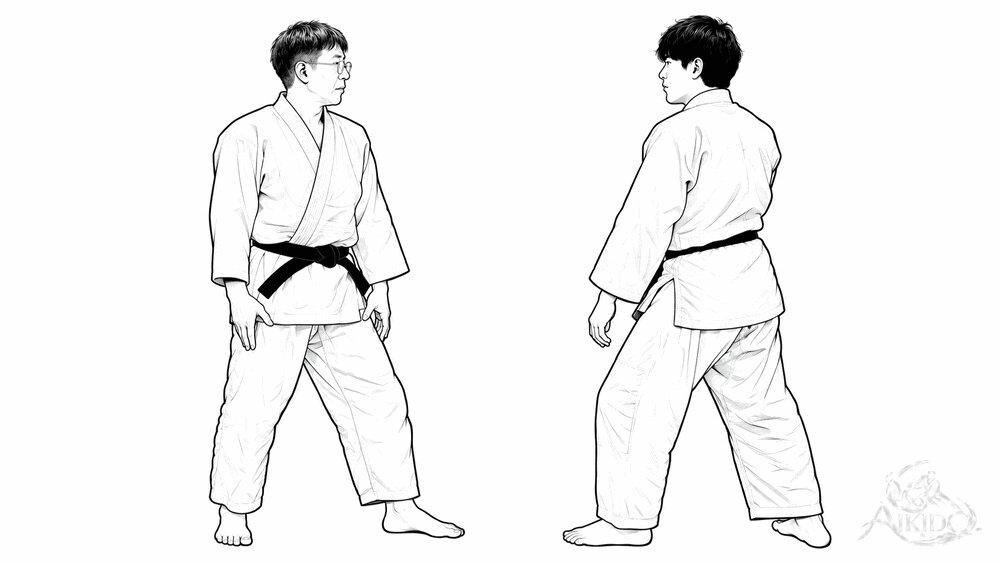
Tai Sabaki (体さばき) 6 — Uchi Kaiten (内回転) (Gyaku-hanmi Katate-dori)
Key point: Link ayumi-ashi and tenkai-ashi to lift your partner up and break their balance.
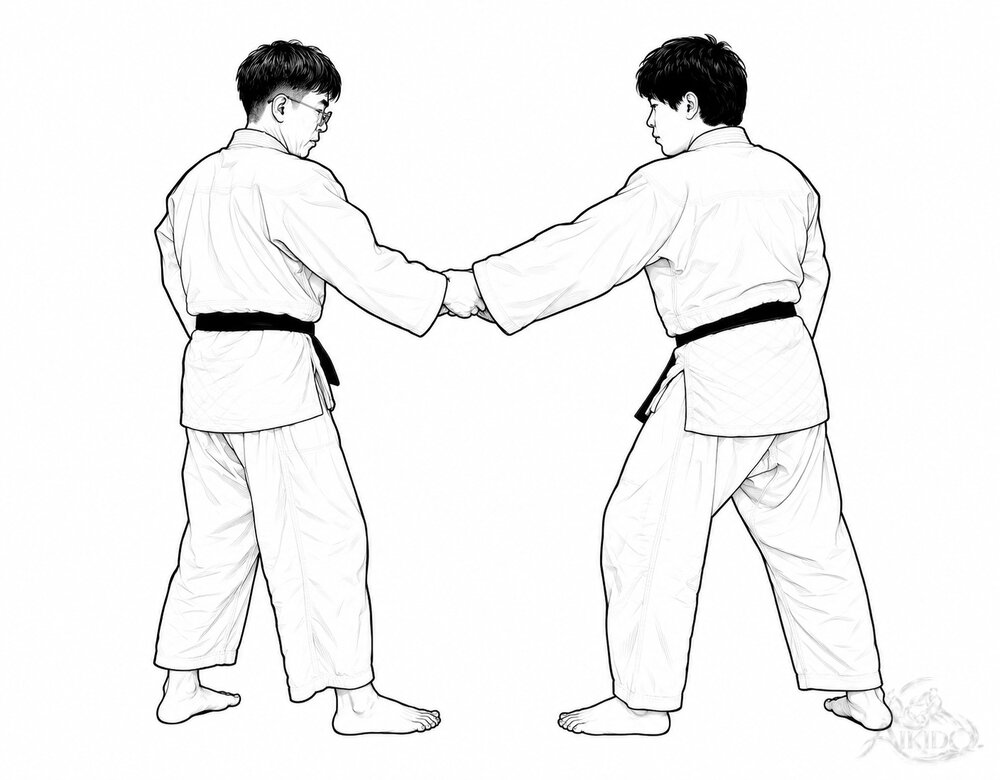
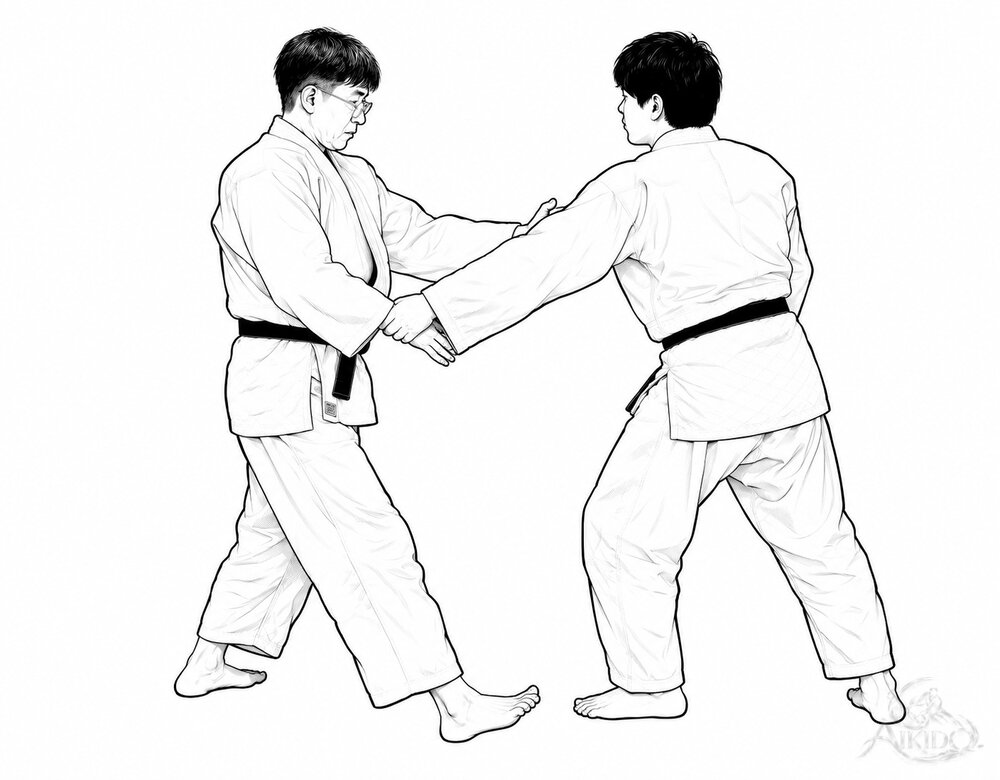
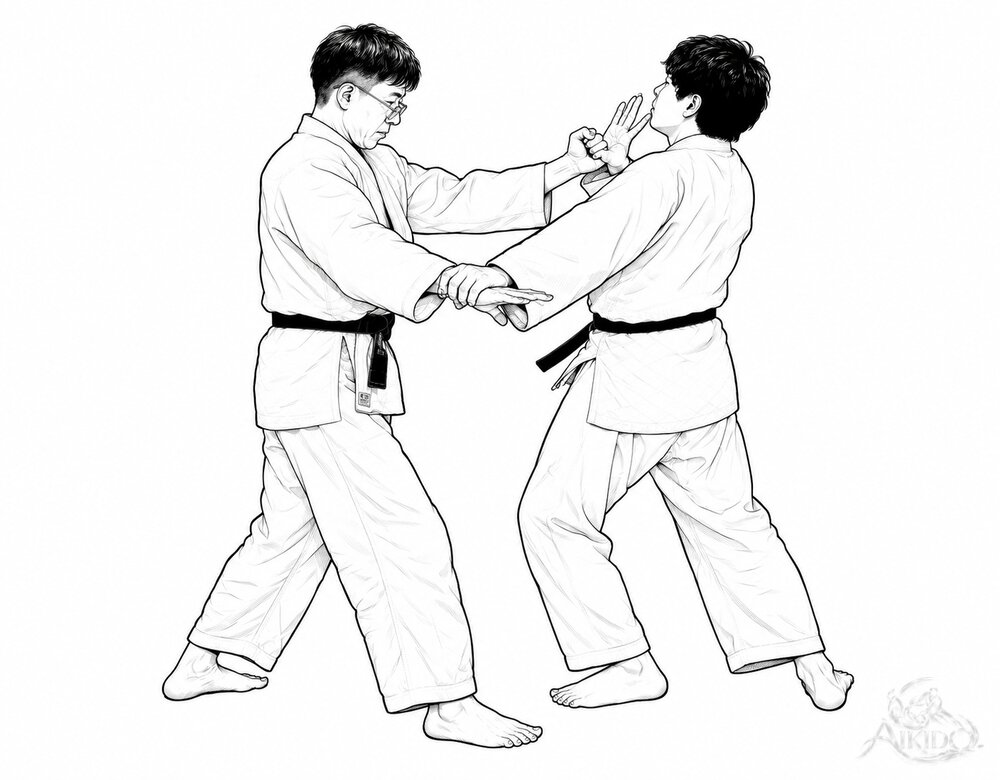
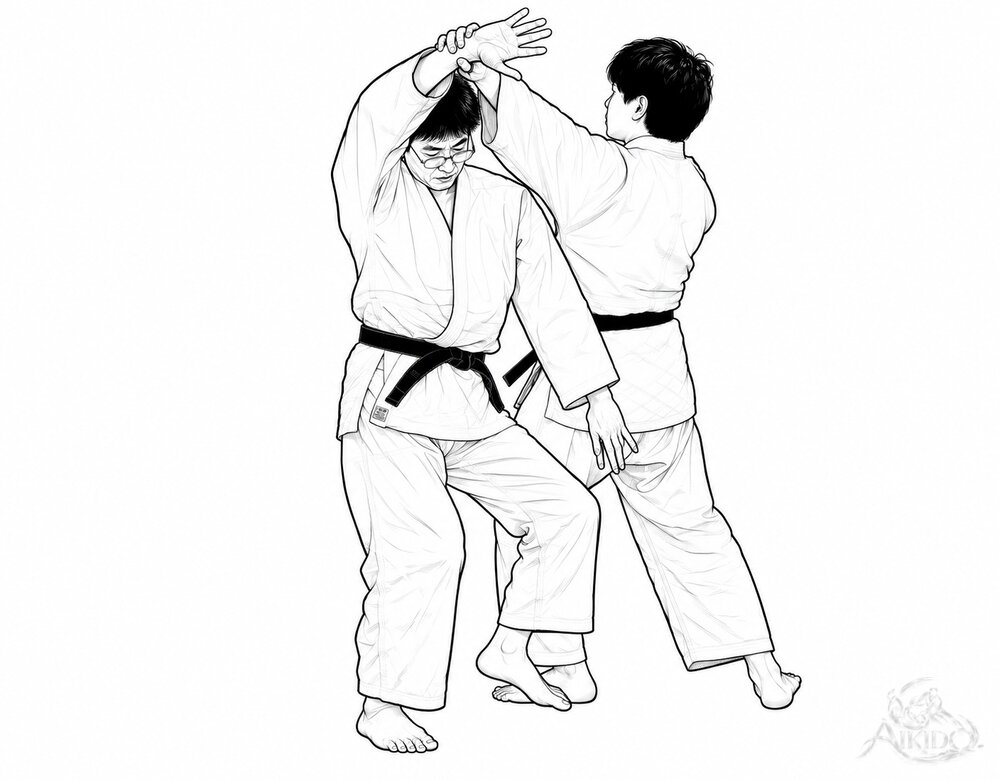
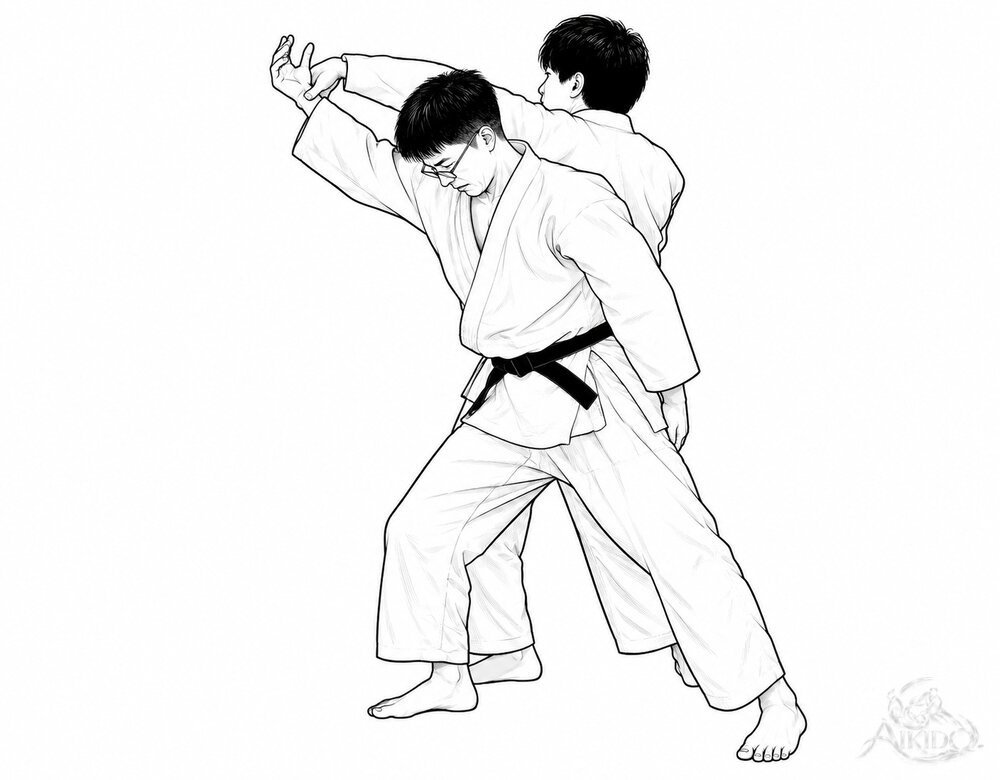
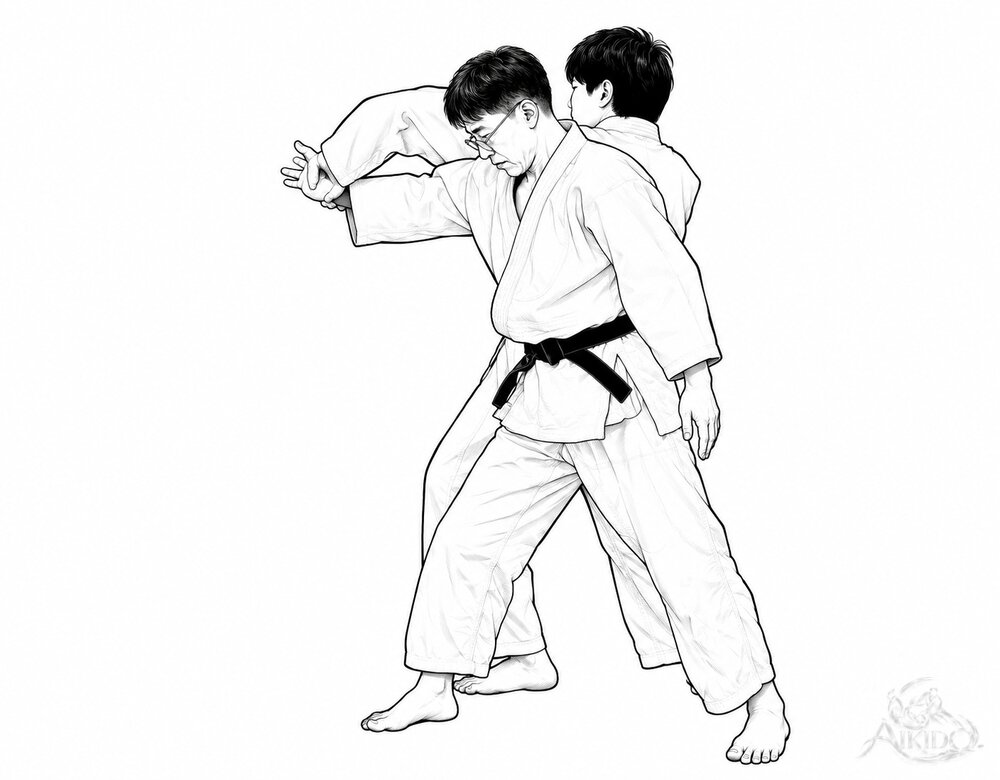
1 Migi gyaku-hanmi katate-dori → 2 Stepping the right foot forward, slip the right tegatana to your partner’s side and deliver atemi with the left hand → 3 Step the left foot in ayumi-ashi again, raising the tegatana → 4 Turn 180 degrees in tenkai-ashi → 5 Turning the hips firmly and returning to hanmi, cut the right tegatana down toward your center
This body movement raises the tegatana from gyaku-hanmi katate-dori and turns the body 180 degrees to break your partner’s balance. In migi gyaku-hanmi katate-dori, enter forward right foot first with okuri-ashi, slipping the right tegatana to your partner’s side and delivering atemi with the left hand. Step the left foot in ayumi-ashi again and cut the right tegatana up as if drawing an arc. Turn the body 180 degrees in tenkai-ashi, form a clear hanmi, and cut the right tegatana down toward the center of your body.
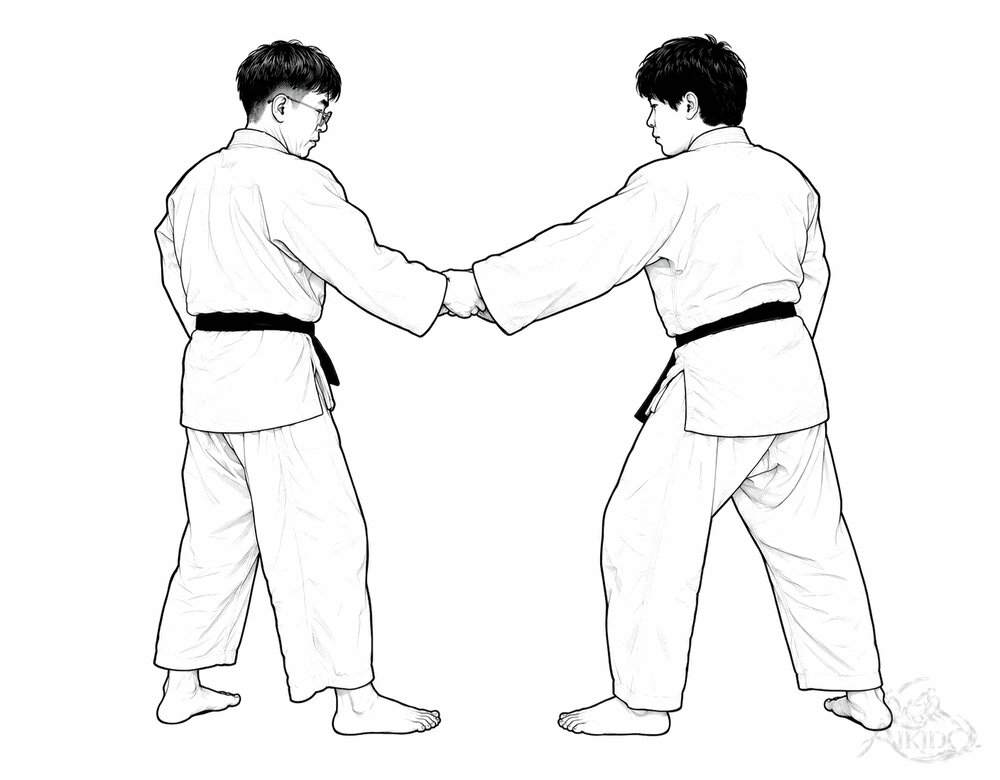
- Deliver atemi: As you slip the tegatana to your partner’s side on entering with okuri-ashi, make a fist with the other hand and deliver atemi aimed at your partner’s face. This atemi lets you carry out the turning movement that follows with confidence.
- NG — Do not duck through: When you turn the body under the raised tegatana, do not bend the upper body to duck through. Keep your back straight, raise the tegatana, and pass through by turning the hips. Do it with the feeling of passing under the hand.
- Combining ayumi-ashi and tenkai-ashi: This body movement uses footwork combination 2 (ayumi-ashi and tenkai-ashi). Match the turning of the hips with the turning of the feet, and after the turn return clearly to hanmi.
Tai Sabaki (体さばき) 7 — Soto Kaiten (外回転) (Gyaku-hanmi Katate-dori)
Key point: Enter to your partner’s side in tenkan-ashi and lift your partner up to break their balance.
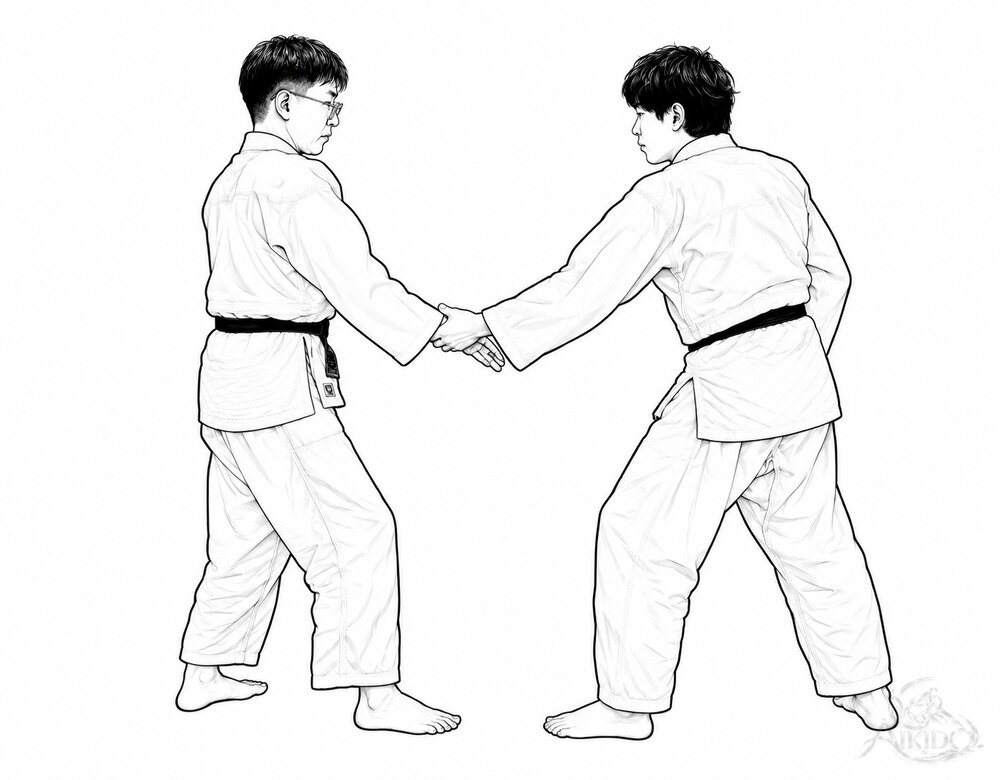
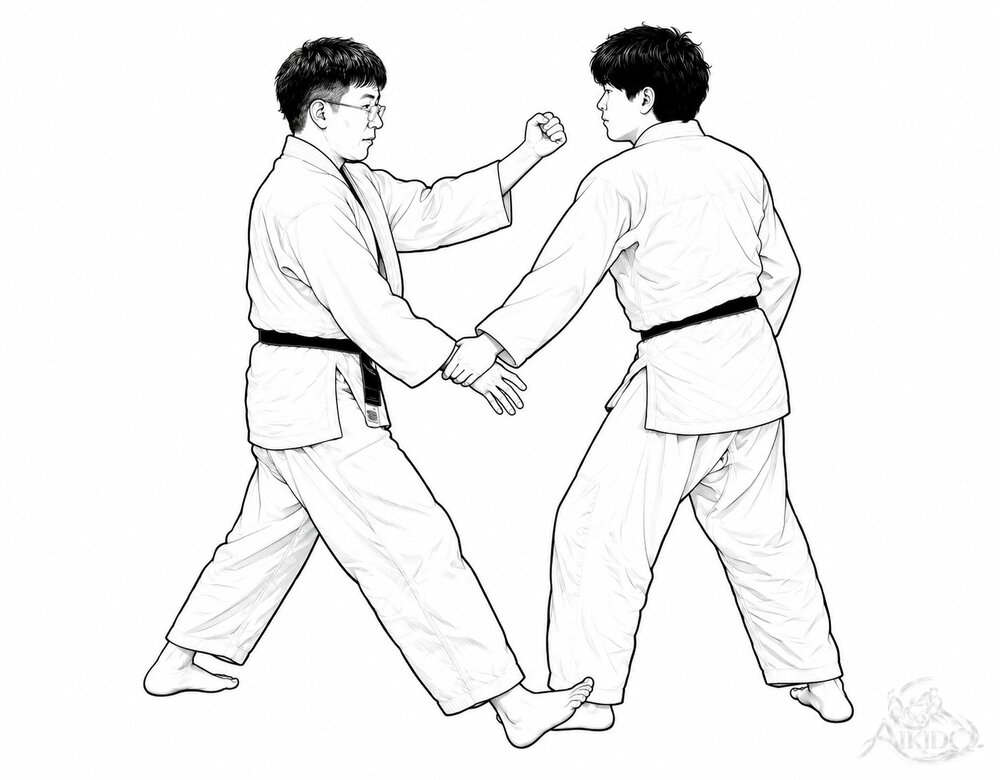
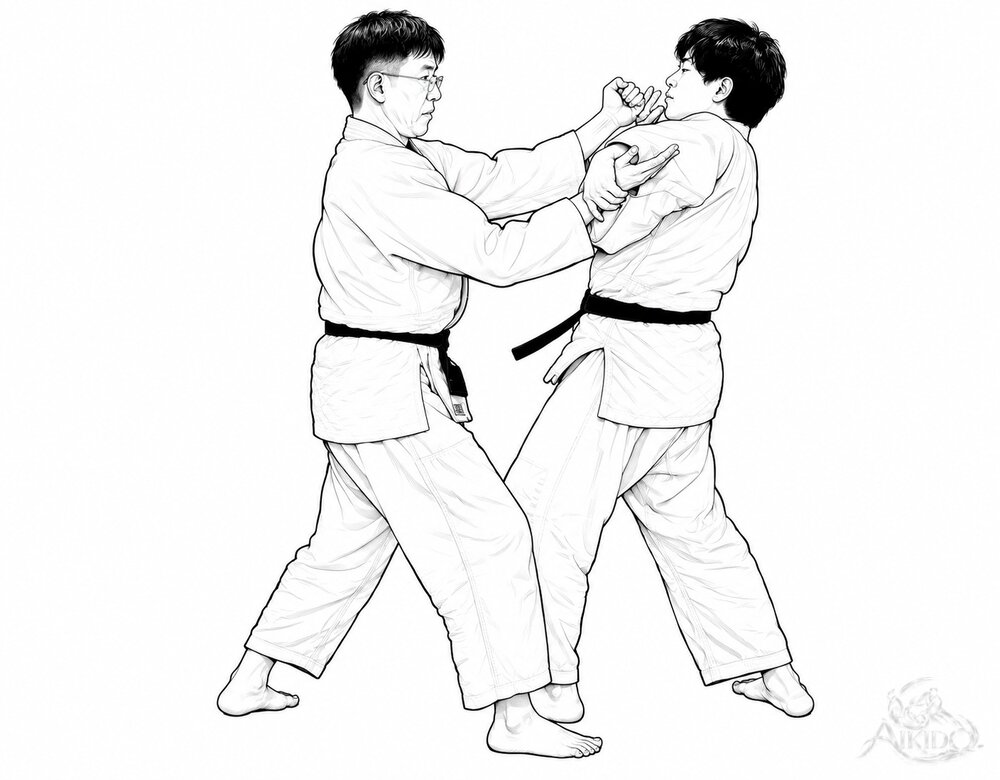
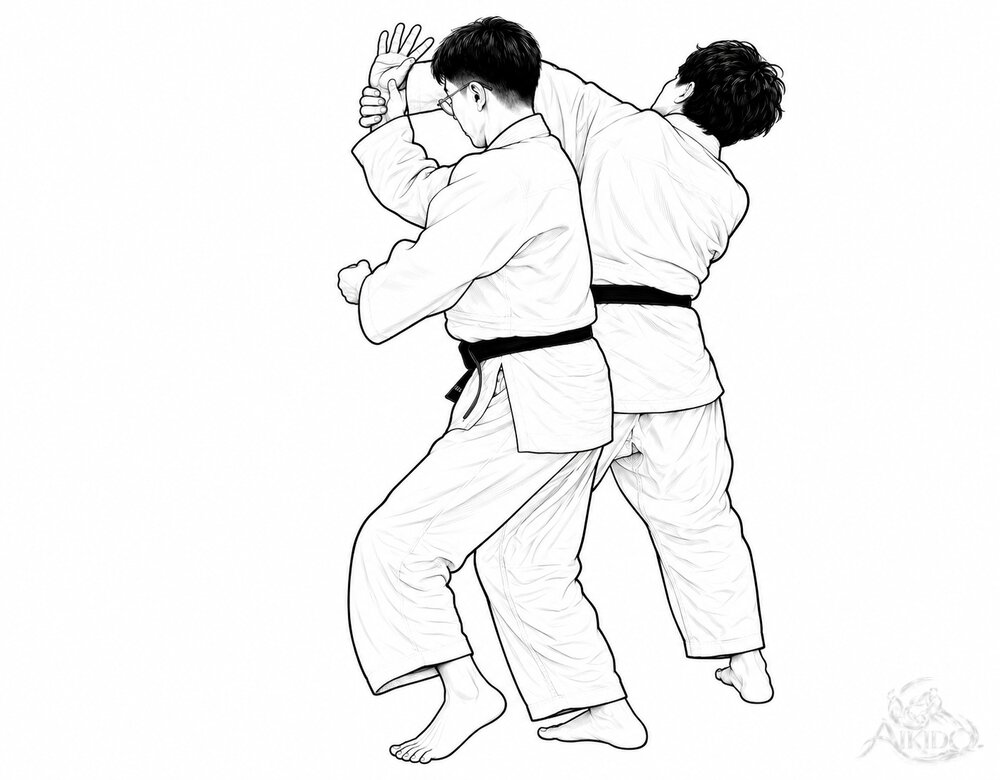
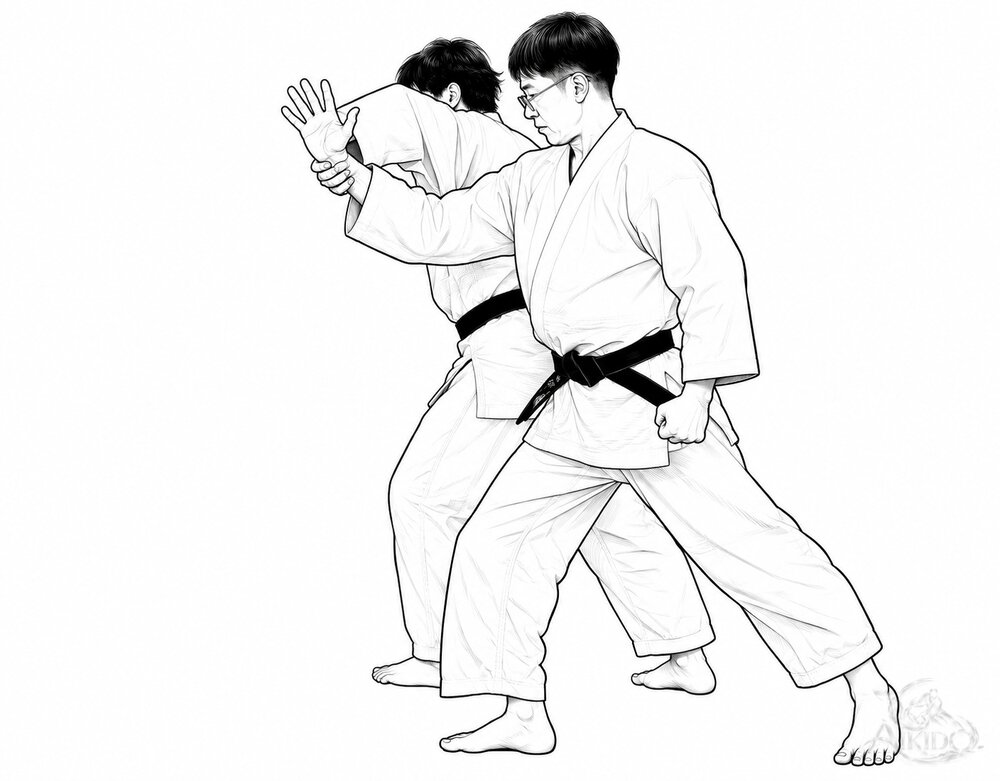
Up to the point of entering one step from gyaku-hanmi katate-dori, slipping the tegatana to your partner’s side, and delivering atemi, this is the same as uchi kaiten. In soto kaiten, you then turn the body backward in tenkan-ashi to break your partner’s balance. In migi gyaku-hanmi katate-dori, with the right tegatana slipped to your partner’s side and atemi delivered with the left hand, draw the left foot back in tenkan-ashi on the right foot and turn the body 180 degrees. In time with this movement, raise the right tegatana and break your partner’s balance as if lifting them up. This is the tsuridashi (つり出し) you learned in Chapter 2.
- How to use the tegatana: First, slip the tegatana to your partner’s side on the first step. Then, in time with the movement of tenkan-ashi, lift it with the feeling of bringing your elbow in toward your partner’s chest, and bring it to your center on an arcing path.
- Swing the back foot (tenkan-ashi): Uchi kaiten uses okuri-ashi, ayumi-ashi, and tenkai-ashi, but soto kaiten turns the body and breaks your partner’s balance with just two: okuri-ashi and tenkan-ashi. The moment you step out with the right foot, quickly swing the left foot back with that foot as the pivot. Turn with your axis kept straight, and after turning form a clear hanmi.
Tai Sabaki (体さばき) 8 — Shiho-giri (四方斬り) (Irimi)
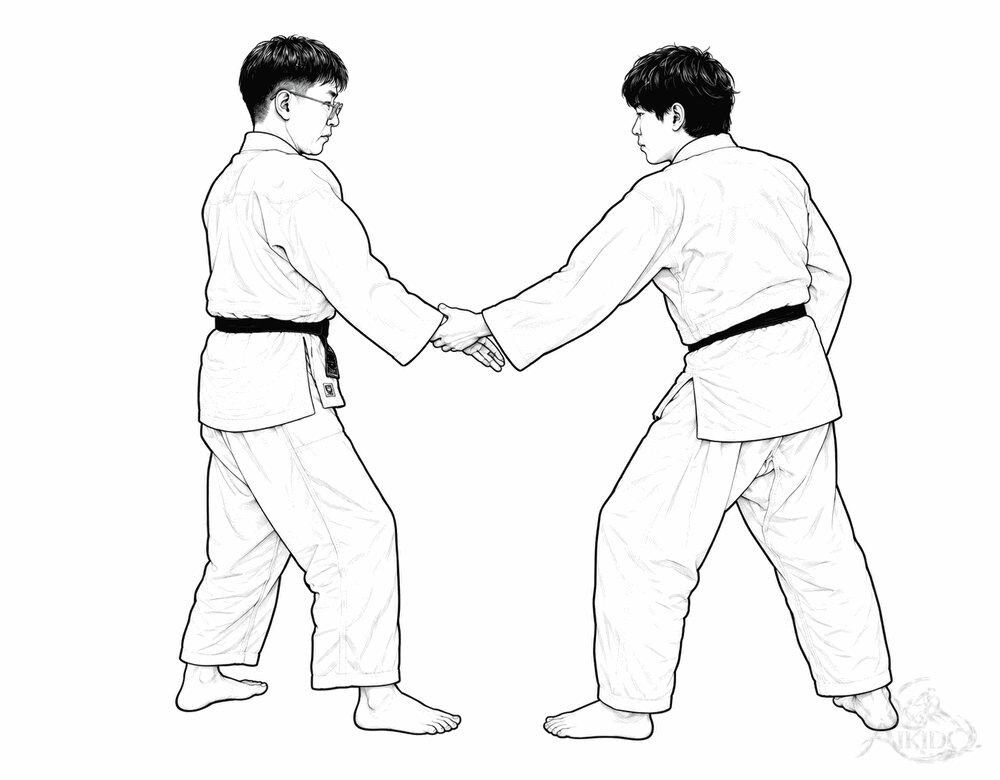
Key point: From ryote-dori, enter with irimi, cutting the tegatana up and then down.
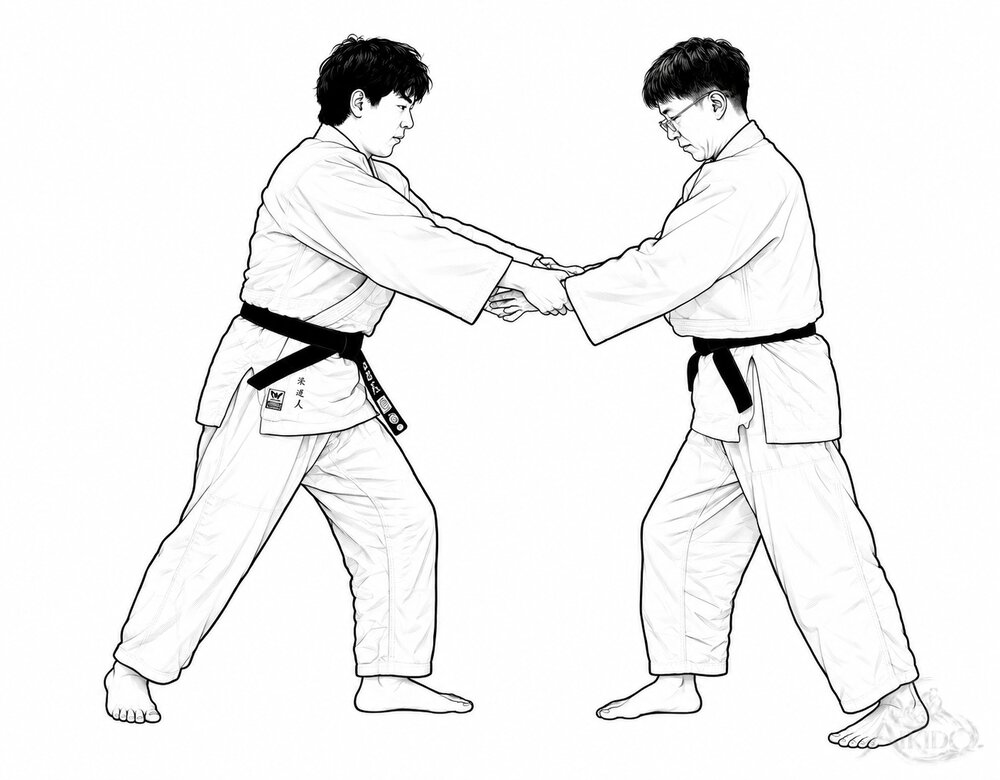
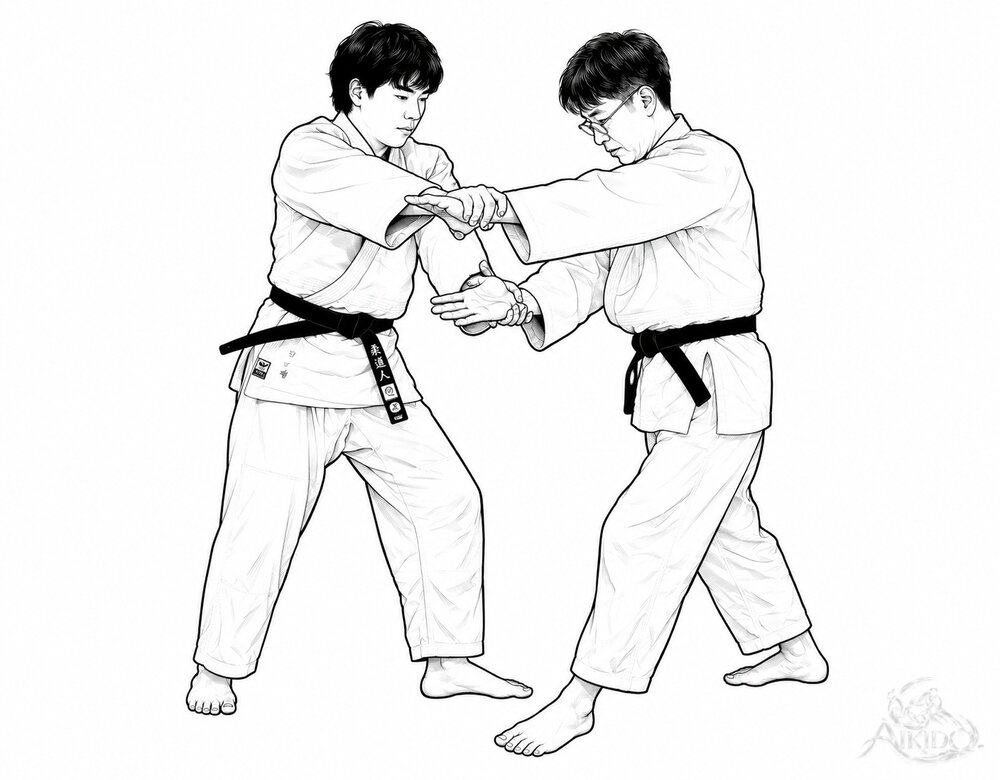
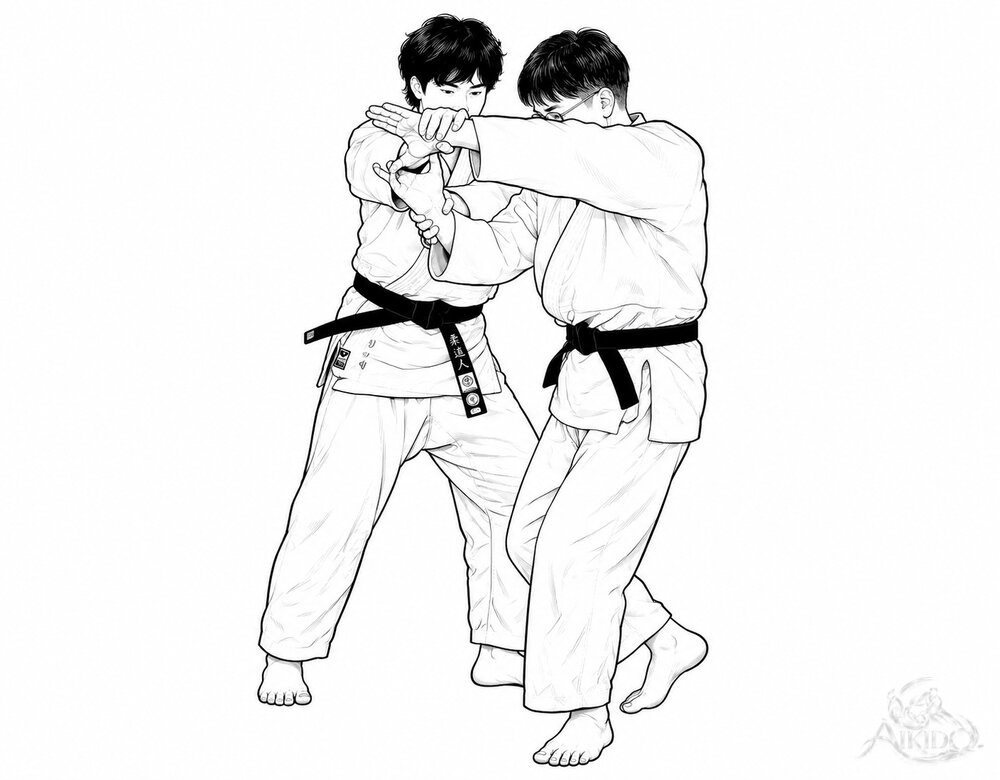
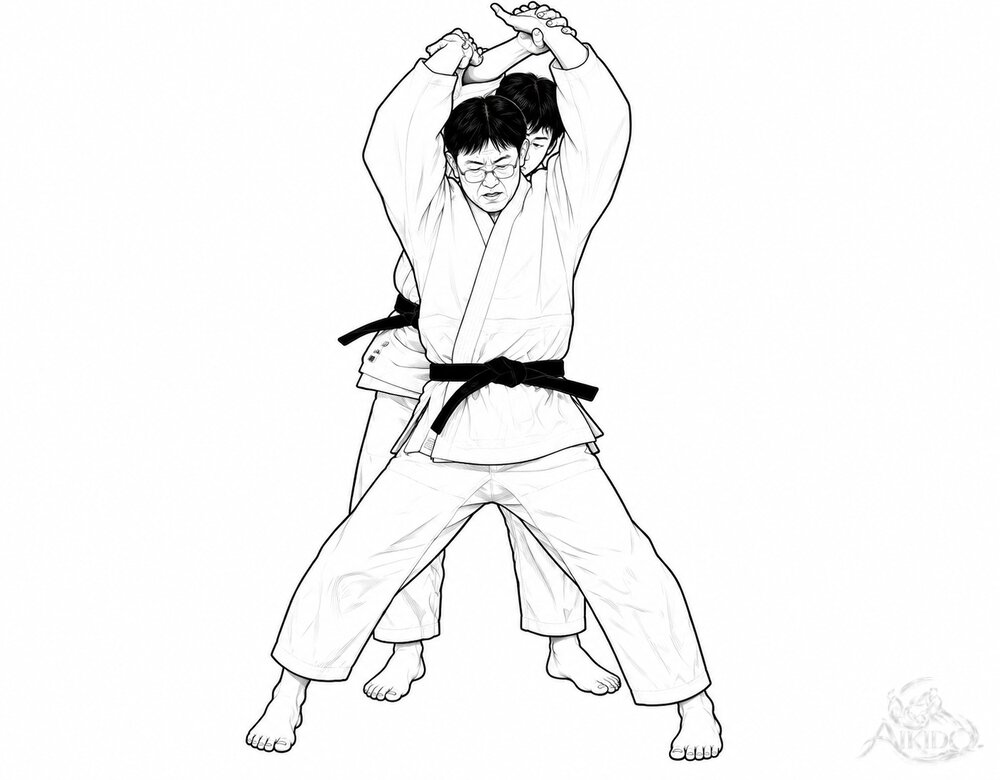
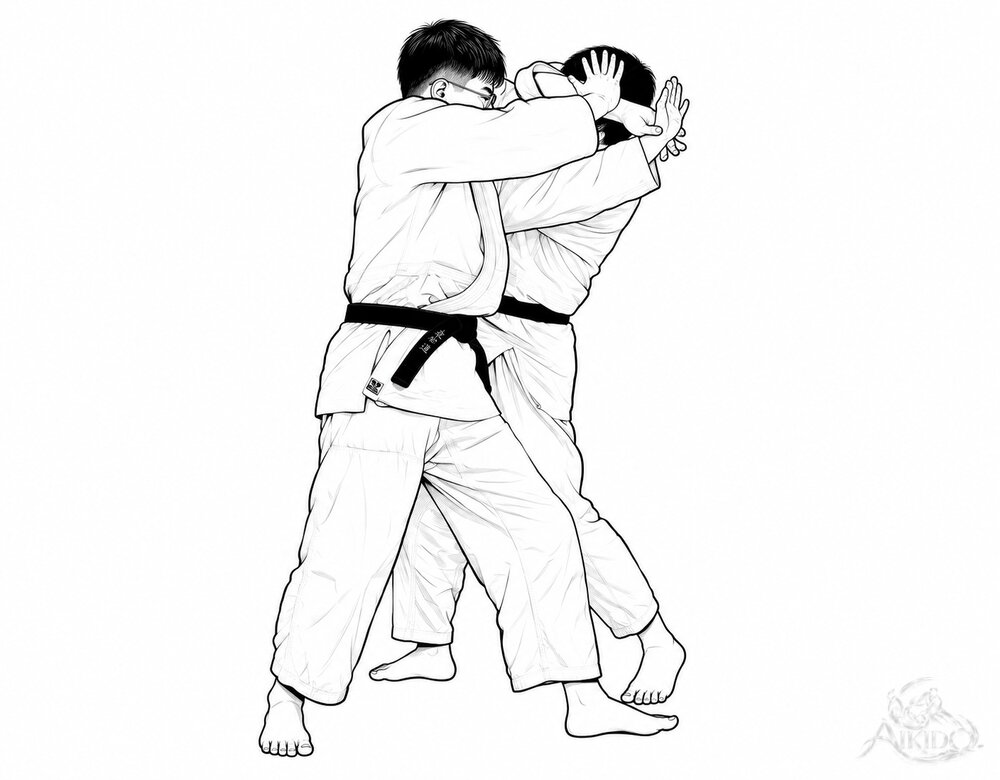
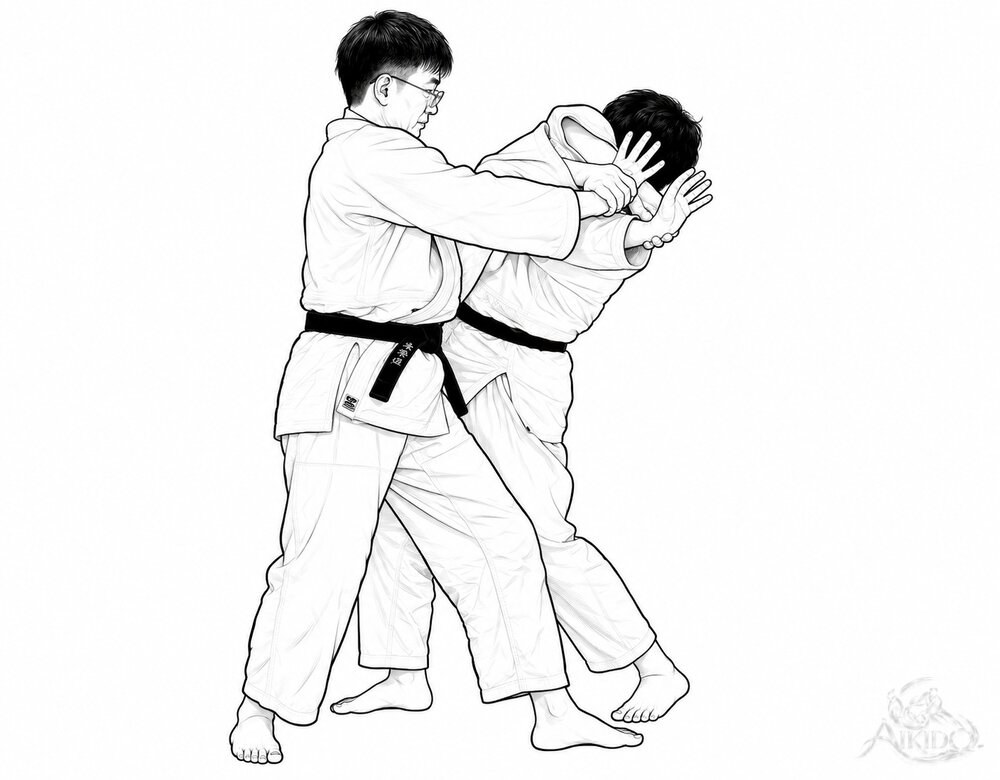
From ai-hanmi ryote-dori, this body movement enters with irimi to your partner’s side while cutting the tegatana up, then turns the body 180 degrees in tenkai-ashi while cutting the tegatana down to break your partner’s balance. In migi ai-hanmi ryote-dori, step the left foot (the back foot) forward in ayumi-ashi while cutting the tegatana up along the center of the body. Then, turning 180 degrees in tenkai-ashi, cut the tegatana down without letting it stray from the body’s center. Finally, it is important to form a clear hanmi.
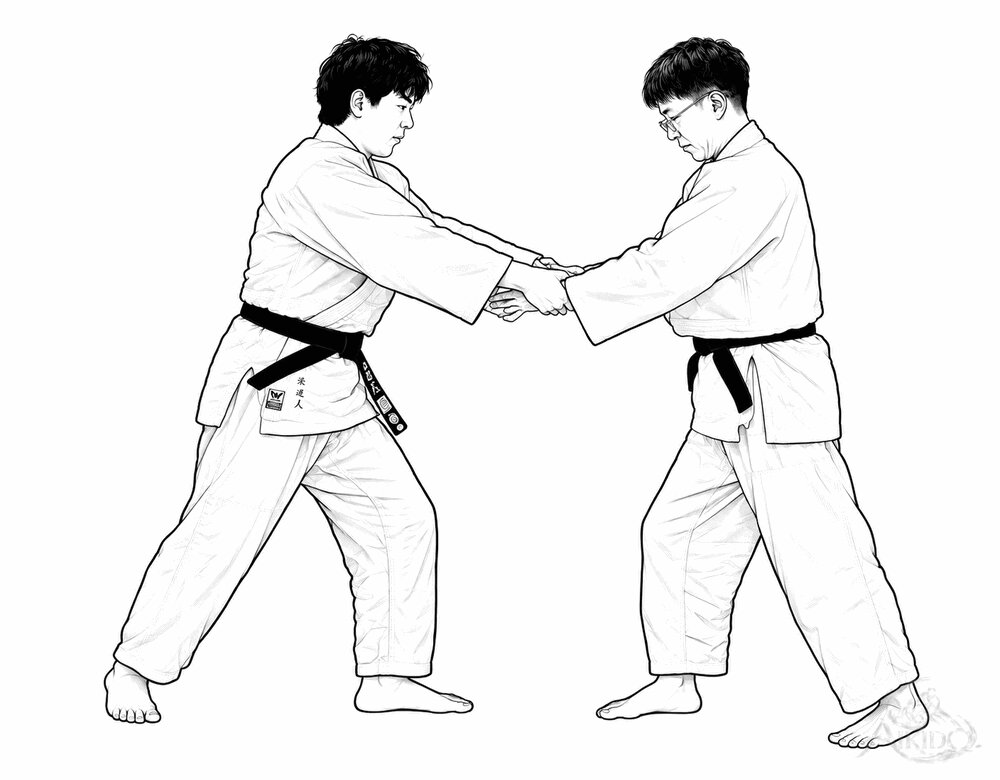
- Cut along the center of the body: The body’s direction changes by 180 degrees, but the tegatana always follows the center of the body. If it strays left or right, the balance of the whole body collapses and the body movement loses its effect.
- Form a clear hanmi: After turning 180 degrees in tenkai-ashi, form a clear hanmi stance. In aikido hanmi is the most stable posture, and you always keep it when applying a technique. Complete your hanmi clearly, and cut the tegatana straight down toward the body’s center.
Tai Sabaki (体さばき) 9 — Shiho-giri (四方斬り) (Tenkan)
Key point: From ryote-dori, turn with tenkan, cutting the tegatana up and then down.
From gyaku-hanmi ryote-dori, this body movement turns 180 degrees in tenkan-ashi while cutting the tegatana up, then turns another 180 degrees in tenkai-ashi while cutting the tegatana down. In migi gyaku-hanmi ryote-dori, on the right foot, draw the left foot far back and turn the body 180 degrees. At the same time, cut the tegatana up along your center, and move straight into tenkai-ashi. Turning the body 180 degrees, cut the tegatana straight down toward the body’s center to complete the unbalancing.
- Cut up while turning with tenkan: Make use of the turning power created by tenkan-ashi as you cut the tegatana up along your center. If the body wobbles or the tegatana strays from the center, it will not flow into the next movement, so take care.
- Cut down while holding your axis: Shiho-giri (tenkan) uses the combination of two kinds of footwork, tenkan-ashi and tenkai-ashi (footwork combination 3), linking the cutting up and cutting down of the tegatana to break your partner’s balance. Because the body’s turns follow one after another, holding the body’s axis is all the more important. Especially as you cut down, keep your center firmly between both feet.
Last updated November 1, 2026 · This book continues to be revised after publication.
© 2026 Moon Young-chan. All rights reserved.
The text and images of this book are protected by copyright and may not be reproduced or distributed without permission.