
What Is Aikido?
The Meaning of Aikido (合気道)
Aikido is written 合気道 in Chinese characters. These three characters hold everything this martial way aims for.
- Ai (合) means “to join, to bring together as one.”
- Ki (気) is the energy that moves body and mind, and also the strength and intention of your partner.
- Do (道) means a path you walk for a lifetime.
Read together, they mean “the way of harmonizing your ki with your partner.” In aikido you do not meet force with force. You receive the force your partner pushes in with, fit your body to that flow, and lead your partner. This is why people who are not strong, and people who are no longer young, can keep training (keiko, 稽古) for many years.
The Founder, Morihei Ueshiba (植芝盛平), and the History of Aikido
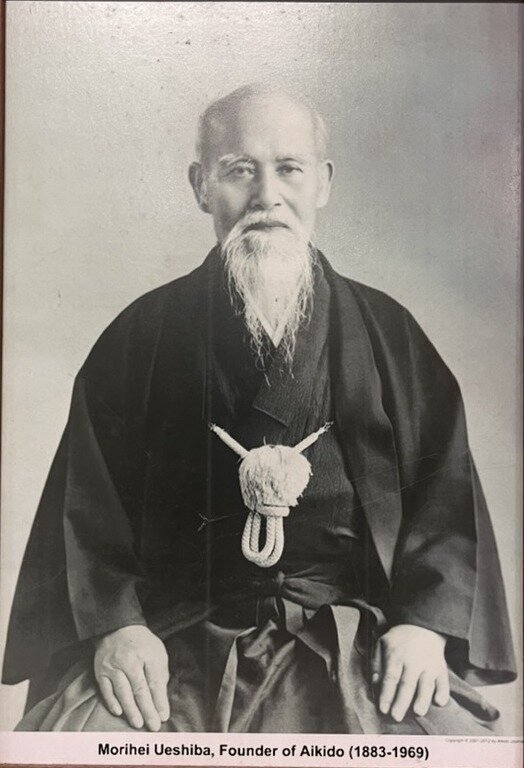
Aikido is a modern martial way created by Morihei Ueshiba (植芝盛平, 1883–1969), who studied Japan’s traditional martial arts in depth and then went through rigorous spiritual training.
As a young man, the Founder (Kaiso, 開祖) studied several schools of jujutsu (柔術). In 1908 he received a teaching license in Goto-ha Yagyu-ryu (後藤派柳生流) jujutsu. In 1911 he moved to Hokkaido as a settler, met Sokaku Takeda (武田惣角), and learned Daito-ryu (大東流) jujutsu. He was later deeply influenced by Onisaburo Deguchi (出口王仁三郎) of the Omoto religion (大本教), and in 1919 he opened a training dojo, the Ueshiba Juku (植芝塾), in Ayabe (綾部), Kyoto Prefecture.
Through years of training body and mind, the Founder came to call the true meaning of the martial arts “the way of aiki (合気の道).” In 1931 he built a dedicated dojo, the Kobukan (皇武館), in Shinjuku, Tokyo; it is today’s Aikido Hombu Dojo (本部道場, the headquarters dojo). In 1940 the Kobukai Foundation (皇武会) was officially recognized, and in 1942 the name “aikido (合気道)” was used for the first time. In 1948 the organization was reorganized and started again as the Aikikai Foundation (合気会).
His son Kisshomaru Ueshiba (植芝吉祥丸, 1921–1999), who became head of the Hombu Dojo in 1948, devoted himself to spreading aikido. He set up branch dojos across Japan and sent instructors to universities, and when the Founder passed away in 1969 he became the second Doshu (道主, head of the aikido lineage) and led its spread overseas. The International Aikido Federation (IAF) was founded in 1976. Since 1999 the Founder’s grandson, Moriteru Ueshiba (植芝守央, b. 1951), has led aikido as the third Doshu.
| Year | Event |
|---|---|
| 1883 | Morihei Ueshiba is born |
| 1908 | Receives a license in Goto-ha Yagyu-ryu jujutsu |
| 1911 | Moves to Hokkaido; learns Daito-ryu jujutsu from Sokaku Takeda |
| 1919 | Opens the Ueshiba Juku in Ayabe, Kyoto Prefecture |
| 1931 | Founds the Kobukan (today’s Hombu Dojo) in Tokyo |
| 1940 | Kobukai Foundation officially recognized |
| 1942 | The name “aikido” is used for the first time |
| 1948 | Aikikai Foundation established; Kisshomaru Ueshiba becomes head of the Hombu Dojo |
| 1969 | The Founder passes away; Kisshomaru becomes the second Doshu |
| 1976 | International Aikido Federation founded |
| 1999 | The second Doshu passes away; Moriteru Ueshiba becomes the third Doshu |
Aikido Today
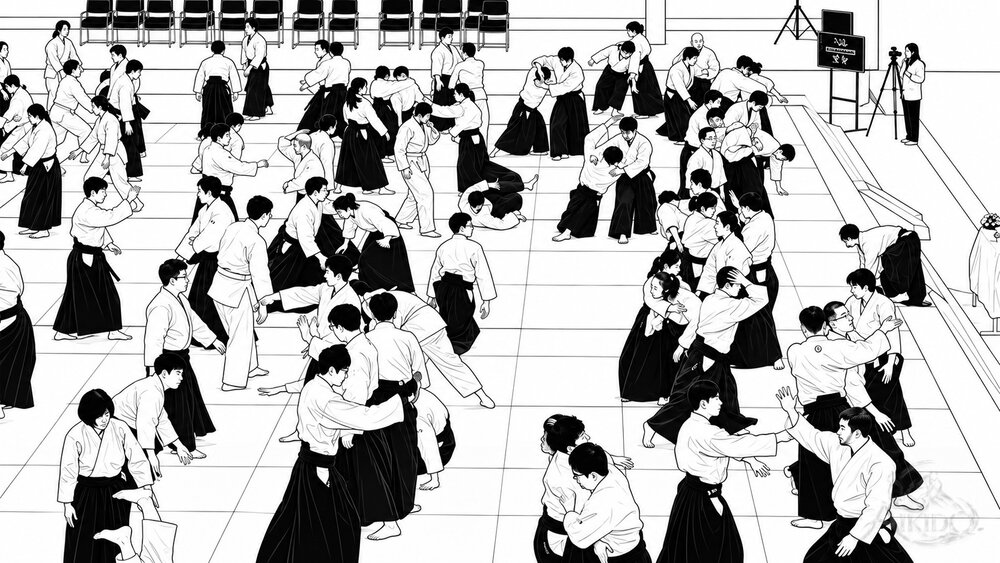
The aim of aikido is not to fight your partner. It is to polish your skills together with the people you train with, and to strengthen body and mind. That is why aikido has no competitions to decide who is better. Two people take turns applying and receiving a technique, repeating the same technique at a level that suits each other’s skill. Training with respect for your partner in this way is aikido’s greatest feature and its greatest appeal.
Aikido began in Japan and is now practiced in countries all over the world. The Hombu Dojo in Tokyo still holds classes every day, and students come there from around the world.
Aikido in Korea and the Korea Aikido Federation
In Korea, the organization that has officially carried on the aikido of the Aikikai is the Korea Aikido Federation ((사)대한합기도회). Jeju Oseung Dojo is one of its member dojos.
The Federation’s roots go back to an exchange with Taiwan in 1988. After first encountering Morihei Ueshiba’s aikido through that exchange, its founders formed the Korea Aikido Promotion Society in 1989, widened their exchanges abroad, and began to take up aikido in earnest. On February 29, 1996, the group was formally registered with the Aikikai World Headquarters.
The organization was later renamed Korea Aikikai (한국합기회) and then (사)대한아이키도연맹, whose English name was the Korea Aikido Federation. Its Korean name has since changed to (사)대한합기도회, but it still uses the English name Korea Aikido Federation. In August 2003, with the approval of the Aikikai Doshu, it was recognized as the aikido organization representing Korea. Only an organization that represents its country can take part in the International Aikido Federation on that country’s behalf.
Every year the Federation invites Aikikai shihan (師範, master instructors) to hold international seminars (講習会) and demonstrations (演武会). At these events members train alongside students from Korea and from many other countries. Aikido is a martial way you can comfortably practice with the local people in any country you visit, because the training itself works as a common language.
Why Train in Aikido?
At Jeju Oseung Dojo, members from their twenties to their sixties train together. What each age group gains from aikido is a little different.
- You learn to use your body. Aikido techniques are applied not with arm strength but with the power that comes from using the whole body together, called kokyu-ryoku (呼吸力, breath power). As you keep training, good posture and a sense of balance come naturally.
- You learn how to fall. Once you have learned ukemi (受け身, breakfalls), you are much less likely to be badly hurt when you slip or fall in daily life. Middle-aged and older members feel this benefit most.
- You become more flexible and fit. Just practicing basic movements such as shikko (膝行, knee walking), wrist exercises, and ukemi steadily makes your joints supple and your legs strong.
- You learn to calm the mind. Training that does not contest strength with your partner but fits to their movement carries over directly into how you deal with people.
With no competitions, there is no need to compare yourself with others. Being a little better than you were yesterday is enough. That is why aikido is a martial way you can practice for life, at any age.
Last updated October 31, 2026 · This book continues to be revised after publication.
© 2026 Moon Young-chan. All rights reserved.
The text and images of this book are protected by copyright and may not be reproduced or distributed without permission.